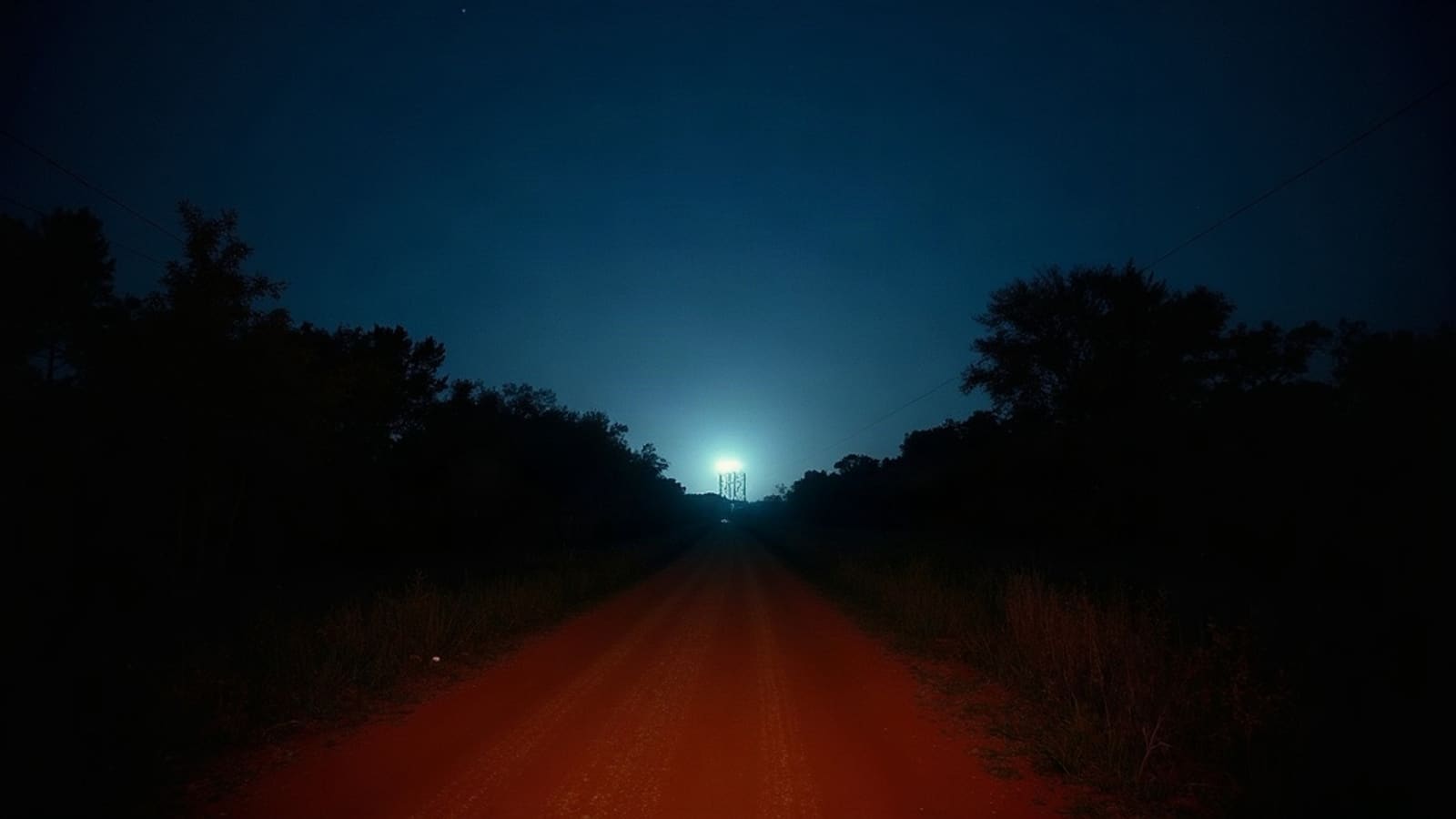
UAP · Ndola, and the Copperbelt towns of Kitwe, Chingola and Bancroft (now Chililabombwe), Zambia · 1956-07-03
Sundowner time on the Copperbelt
Ndola in the dry season is a town of red dust and blue woodsmoke, and early on a winter morning the sky to the north of it, out towards the Congo border, is usually empty. On one such morning in July 1956 a railway employee named L Walker looked that way and found something in it: a round, silvery object, hanging in one spot.
He watched it, he said, for about four minutes. It stayed put, shifted a little, and then, with no warning at all, began to fade, and within seconds there was nothing to look at. Other railway men saw it too and had a name ready, because in 1956 a round silvery thing that hovered was a flying saucer. The staff of a firm called Harry S Hopkins and Co saw it as well, so the report had a respectable spread of witnesses.
The Met Office was asked the obvious question and ruled itself out. The daily weather balloons went up at half past five, it said, and would have been long gone by eight. That answer is more useful than it looks. The report never says what time Mr Walker looked up; the balloon men’s alibi is the only clock in the story.
Five weeks later the Copperbelt had a second visitor, and this one had an itinerary. On the evening of 9 August, after dark, a bright, flickering light was reported over Ndola, Kitwe, Chingola and Bancroft, which happen to be the mining towns in order up the line towards the Congo, as though something were making an aerial survey of the copper. That phrase is the report’s own, as Flying Saucer Review printed it in its September/October 1956 issue, and the Review liked it well enough to use it twice.
What makes the August night worth keeping is how the witnesses were recruited. The Copperbelt bars of 1956 were warm and full, the copper boom being at its height, and the report describes men being fetched out of them into the cold by friends who said there was something in the sky. They came out laughing at what they took for a wind-up. The laughing stopped, the report says, once they looked up: the light hung there, and then it darted away.
The usual explanations were tried and, the report says, found wanting. No aircraft was scheduled over that irregular route. It was not a meteorological balloon, and a balloon would not have shown up in the dark in any case. The Rhodesia Sunday Mail, published in Salisbury, allowed that sceptics could laugh at stories of “lights flashing in the sky just around sundowner time”, and then declared, without a shadow of doubt on its part, that a mystery object had been over Northern Rhodesia that week.
Cynthia Hind reprinted both items in 1992 as flashbacks and added nothing. Loren Gross, the Californian who filed every 1956 cutting he could find into monthly booklets, has the August tour on his page 22, between a police sergeant at Tarrytown, New York, and a letter from Quebec. Nobody, then or since, seems to have asked what a railway yard and four mining towns look like from above, or why anything would want to know.
The final stop on the survey has since left the map. Bancroft became Chililabombwe in 1967. Gross’s booklet, which carries only the August tour, spells it Bancroff, so the last town the light was reported over is misspelt in one record and renamed out of existence everywhere else.
Others saw something near here
Everything works on wavelengths
An engineer said an object hung over a Kitwe mast for nine hours, on Ndola's radar. Days later a German colleague was found dazed beside a burned imprint.
The photograph Bob kept
Five men in an Alouette on the Congo border, ten seconds of silver-chrome overhead, and one creased photograph from a twenty-pound Agfa camera.