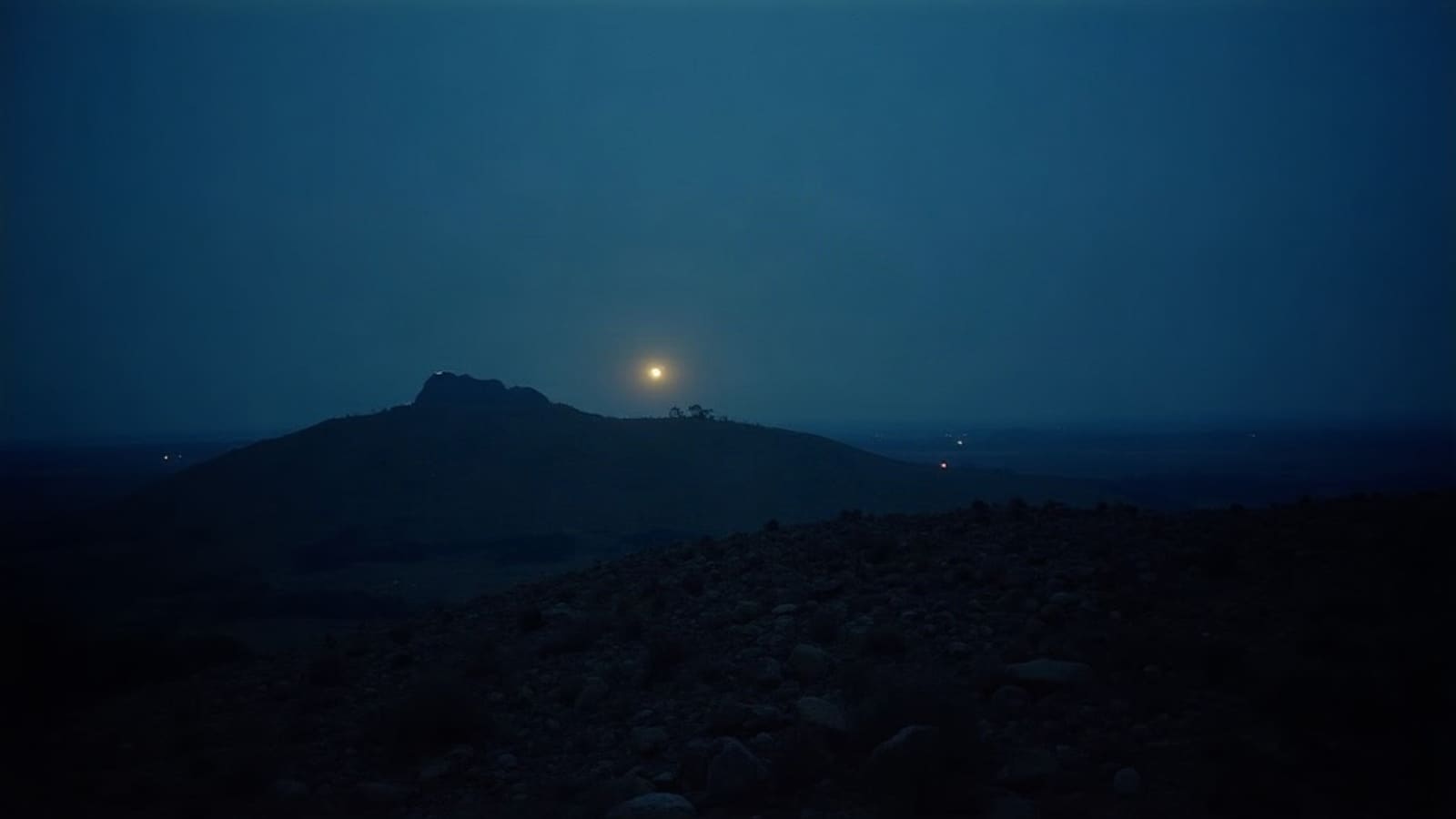
UAP · The hills on the Congo border near Chingola, Copperbelt, Zambia · 1961-10
The photograph Bob kept
Noon on the Copperbelt at the tail of the dry season, when the sky goes white with heat and grass smoke, and an Alouette helicopter was going up and down over the low hills on the Congo border near Chingola, practising landings and take-offs. The men in it were with the forces of the Federation of Rhodesia and Nyasaland, and they were on that border because in the spring of 1961 the border was where the trouble was. Katanga had broken away from the Congo, United Nations troops were fighting its gendarmerie a short way to the north, and a few weeks earlier the UN Secretary-General’s DC-6 had come down in the forest west of Ndola, an hour’s drive away, and the one man pulled out alive had died within the week.
That much is history. The rest came to Cynthia Hind over the telephone, years later, from a man who would say only that his name was Bob.
He told her the day was bright and sunny and the helicopter was at about two hundred feet, doing perhaps 190 kilometres an hour, when something came up from behind a hill at what he called tremendous speed, went straight up and over the top of them, and was gone over the opposite horizon. Ten seconds, he reckoned. No sound, no lights, nothing sticking out of it. “It was a silver-chrome colour and reflected the sun all the time,” he said. Five men saw it: Bob, the pilot Brahm, Chippy Ackerman (killed later in Zaire, Bob said), Gerrie Schultz, and a fifth whose name had gone.
Their first idea was that it was some highly secret United Nations machine, which on that border in that month was not a stupid thought. The shape and the speed soon put paid to it.
Bob had a camera with him, an Agfa that had cost him twenty pounds, and there was time for one frame. He posted the print to Hind on condition that she never learned who he was. It arrived badly creased and rather faint, with an object discernible in it, and, to Hind’s evident pain, somebody had circled the object in ballpoint pen. Joe Brill of MUFON had it analysed by Bill Spaulding of Ground Saucer Watch, who pronounced it a metallic object of disc shape. Hind, ever candid, noted that Spaulding’s reputation had not survived the years, and said she believed his verdict was honest at the time.
Odette Lind, who as a young photojournalist had been sent to the Ndola crash site, added a part Hind’s article does not mention. When the military authorities heard that photographs of such things were being taken during the exercises on the border, she wrote, the order went out to destroy every print and every negative. Bob kept one, out of interest. She never heard the result of the analysis.
Bob was never sure of the date. Late September, he thought, or early October; Hind could not resist pointing out how close that fell to 18 September, and left the rest to her readers. The standard histories put the Federation air force’s first Alouettes on strength in about 1962, a little after Bob’s best guess, which he admitted was only a guess. The magazine did not reproduce the picture. What survives is a description of a creased print with a biro circle on it, the word of five men, three of them named, one of them forgotten, and a phone call from the fifth, who would only ever be Bob.
Others saw something near here
Everything works on wavelengths
An engineer said an object hung over a Kitwe mast for nine hours, on Ndola's radar. Days later a German colleague was found dazed beside a burned imprint.
Sundowner time on the Copperbelt
A silvery object hung north of Ndola and faded. Five weeks later a flickering light toured four mining towns while men were called out of the bars.