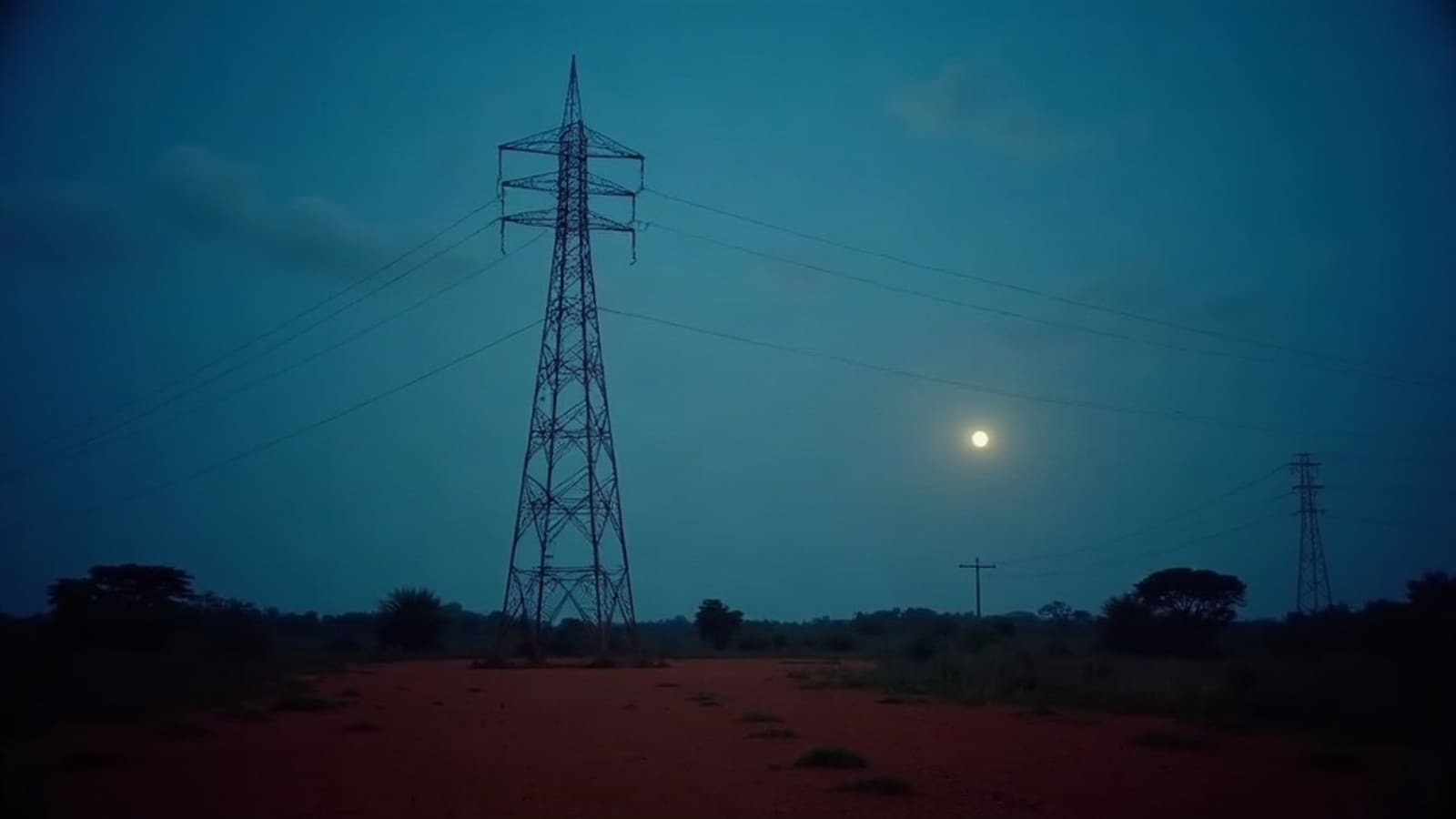
UAP · Transmitter mast outside Kitwe, and the bush beside the Ndola to Kitwe road, Copperbelt, Zambia · 1958
Everything works on wavelengths
High up a new transmitter mast outside Kitwe, on a safety belt, matching up an aerial cable, Henk van der Linden had every reason to keep his eyes on his work. It was 1958 or 1959, he thought. He was a senior engineer with the Federal Broadcasting Corporation, putting up masts on the Copperbelt of what was then Northern Rhodesia, and on the steel with him were Jack Grahame, a young apprentice named Roger Hart and, as he remembered it, Ian McFee. Somebody looked up.
Through gaps in the small, very high fleecy clouds, and well above them, sat something big. Henk’s word for it was still. Not drifting, as a balloon would. Dull white-grey, sharp-edged, shaped like a flattened football or a very thick saucer, and it did not glint. No sound, no smell. He was not frightened, he said, only sure that whoever it was had come to look at what was going on below.
It was there at about eight in the morning, there at two when Henk drove into Kitwe on an errand, and there at five when he got back. Then, with all of them watching, it was simply gone. Jack begged the others not to tell the newspapers, who would assume the transmitter crew had been at the whisky.
Kitwe airport had seen nothing. Ndola had radar, and Ndola, Henk said, reported a return that had held one position on the screen for hours. It was not, they told him, a weather balloon.
A couple of days later, on what he thought was a Saturday, Henk, Dieter Siegerberg of Philips and a third man were driving the hilly Ndola road when they spotted an Opel off in the bush. It belonged to a German engineer delivering parts for the mast. The door was open and the engine still warm. They shouted his name and thought of the murder stories going round. Henk and Dieter pushed into the bush behind the power lines.
They found him sitting on the ground, dazed. Was he sick? No, he said, but “tell me, am I an irrational fellow?” It was about eleven. His story, as Henk retold it, had begun at eight: a big round thing coming down over the road as he drove back from Ndola, settling beyond the hill. He had followed it, walked into the bush, seen it in a clearing, and after that remembered nothing except that he had been inside, knew what it looked like in there, and had understood people who never spoke aloud. Nothing to do with electronics, he told them. Everything aboard worked on wavelengths. Where had he seen it? Right here.
Nearby was the imprint: a broad central base, marks like burns though not from flames, and a circumference of around eighty feet. They had measured it themselves, and he was an engineer, not a fool, so they took his word. He went back to Germany after a while. Henk lost touch with him and never spoke to him about it again.
The account ran in UFO Afrinews in 1996, with Henk noting that all three had seen it, having just named four. Seventeen months later the newsletter printed a correction. Ian McPhee, as the correction spells it, said he had been in Lusaka throughout and first saw the Kitwe station years after it was built. The editors called it an honest slip, one man remembered for another after nearly forty years. Take McPhee off the mast and Henk’s three add up. What remains is the one thing he never doubted: that Ndola’s radar had been watching too.
Others saw something near here
Sundowner time on the Copperbelt
A silvery object hung north of Ndola and faded. Five weeks later a flickering light toured four mining towns while men were called out of the bars.
The photograph Bob kept
Five men in an Alouette on the Congo border, ten seconds of silver-chrome overhead, and one creased photograph from a twenty-pound Agfa camera.