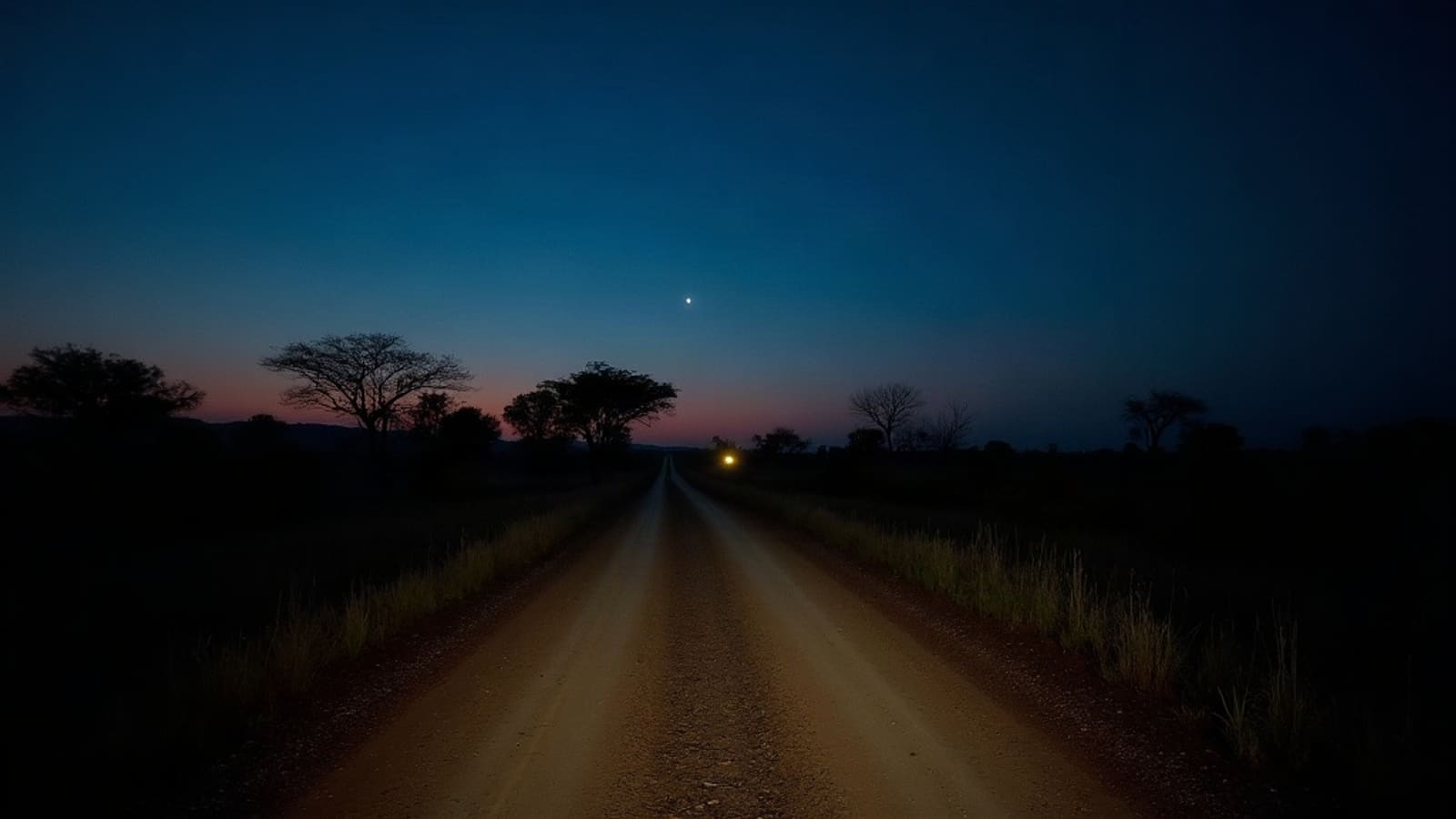
UAP · A strip road about 14,5 km outside Shabani (now Zvishavane), Midlands, Zimbabwe, Zimbabwe · 1975-08-17
The bus that vanished on the Shabani strip road
A strip road was a Rhodesian economy: two narrow ribbons of tar laid down the middle of a dirt road, one for each wheel, so that a car could keep its speed up without the government paying to tar the whole width. When two cars met, both drivers eased off onto the gravel and back on again, and behind every car hung a long plume of dust. Cynthia Hind, writing in 1994, already described them in the past tense. In August 1975 they were still how you got between the small towns of the Midlands, and in August 1975 a good many people in Rhodesia were reporting things they could not account for.
Henry Authers, a bank manager, and his father-in-law L. Sealy were coming back from a prospecting site near the Ngesi River, heading for Shabani, the asbestos town. It was ten past six in the evening, the light going, and Sealy was at the wheel with his foot down. About fourteen and a half kilometres from town they saw a bus ahead of them, travelling the same way. Sealy sped up to catch it. On a strip road that was the usual choice: the alternative was to eat its dust all the way into town.
As they gained on it, Authers began to look at it properly. There were, he said, two people aboard, one seated and one standing, and he wondered why anyone would stand in a bus that was practically empty. Then the bus itself. It was domed. Its windows were panoramic, the pillars between them black and narrower than on any bus he knew. And the inside was lit far too brightly. “There was a very strong white light inside which appeared to throw the person they could see into silhouette,” Hind wrote.
The bus went round a corner. When the car came round the bend, the road ahead was empty. It was a level stretch, about a kilometre and a half of it, and nothing was on it. There was no dust hanging in the air. There was no smell of diesel. The only turn-off was to a rifle range, and the gates of the rifle range were locked. Both men, Hind wrote, had watched the same bus going the same way, and then it was not there. “There was nowhere the bus could have gone.”
Hind put the story in her 1982 book, UFOs: African Encounters, and it might have stayed there. But in July 1993 a Cape Town woman named Avril told Pam Puxley that she and three friends, sitting in a lounge on a Sunday afternoon with a drink, had watched an omnibus, white with black windows, drive straight across the top of a mountain, disappear behind trees, and come out again on another part of the mountain black with white windows. Hind wrote that one up as Case No 78 in the ninth issue of UFO Afrinews, and admitted that a bus was about the least likely shape anyone reports. She had come across it once before, she said: on a strip road outside Shabani, eighteen years earlier, with two men in a fast car trying to catch up.
She offered no explanation for either. Nor does anything in the record say why the man in the empty bus was standing.
In Cynthia Hind's files
The case file behind this story
- Vanishing 'bus' on the Shabani strip road (Authers and Sealy)
Cynthia Hind, UFO Afrinews No 9 (February 1994), spread 14-15
Others saw something near here

The policeman outside Mvuma
A metallic policeman, a lighthouse light overhead, a car that would not slow, and a cabin so cold they wore jerseys while the garage man wore shorts.
Documented
The Hawks over Bulawayo
A shining thing with a cone on top sat over Bulawayo at sunset. Two Hawks went up after it. The air force said it climbed to seventy thousand feet in a minute.