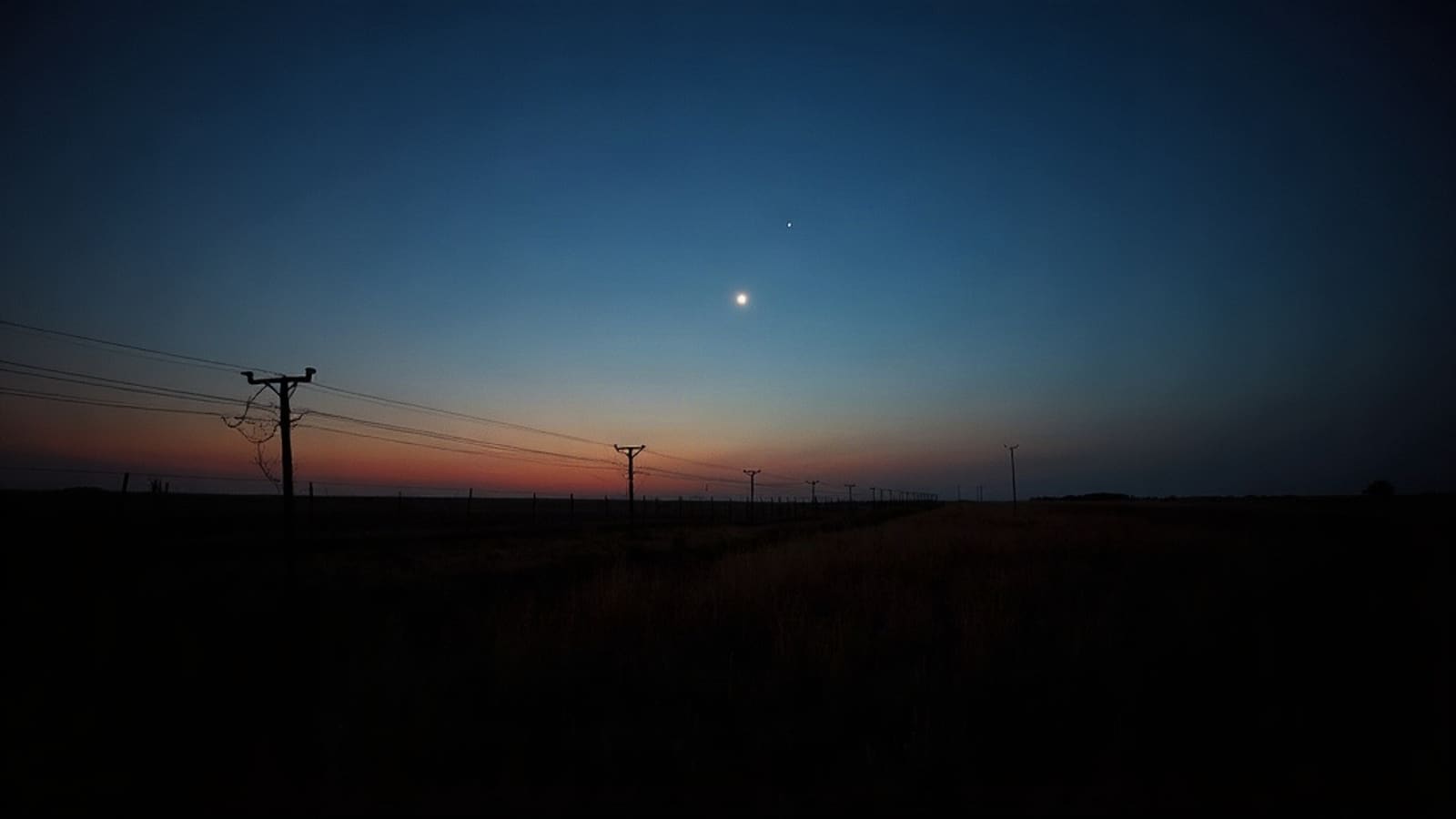
UAP · Bulawayo Airport, Matabeleland, Zimbabwe · 1985-07-22
The Hawks over Bulawayo
At a quarter to six on the evening of 22 July 1985 the sun was going down over Bulawayo, which in July it does quickly and with some colour, and the people in the control tower at the airport were looking at something that was not on their traffic board.
It had come in over the south of the country, fast, and then it had stopped. It hung there. It was round, very bright, with a short cone sticking up out of the top of it, and it caught the sunset the way a polished thing does. People on the ground below the tower saw it too, and pointed, and the word went round the airport buildings. The controllers, by the account the air force gave afterwards, had it on their radar, which was something they could not say about the sun.
The Air Force of Zimbabwe in 1985 was five years old and inherited from Rhodesia, with a Pakistani air marshal on loan to run it and a new squadron of British-built Hawk jets at Thornhill, outside Gweru, a hundred and sixty kilometres to the north-east. Two of the Hawks were scrambled. They got to about seven thousand feet and closed on the object, and the pilots came back with a description that the air force’s director general of operations, Air Commodore David Thorne, repeated to anyone who asked for the next year and a half: incredibly shiny, reflecting the colours of the sunset. As the light went, he said, it became clear that the thing was giving off light of its own.
Then it left. The air force’s estimate was that it went from where the Hawks could see it to around seventy thousand feet in under a minute, and away at something like twice the speed of sound. A Hawk is a trainer with a top speed a good deal below that. The pilots turned for home.
What is unusual about the Bulawayo case is not the sighting but the official response. Air Marshal Azim Daudpota, the Pakistani officer commanding the air force, told The Times of London in early August: “This was no ordinary UFO. Scores of people saw it. It was no illusion, no deception, no imagination.” Thorne, writing that October to the British author Timothy Good, went further, and said that as far as his air staff were concerned, unofficially, the unexplained objects came from a civilisation beyond this planet. Eighteen months later he was still saying the object could not be dismissed as an aircraft, a weather balloon or a natural phenomenon, and that his pilots were completely reliable.
The American sceptic James Oberg, asked about it at the time, was drier. The evidential value of a sighting nobody could go back and research was, he said, zero, however sincere the witnesses, and pilots are trained to see any unfamiliar light as another aircraft because that is what keeps them alive. He also pointed out that Zimbabwe in 1985 sat under a good deal of foreign reconnaissance, some of it Soviet and some of it South African, that nobody was going to admit to.
No balloon launch was ever identified for that evening, and no aircraft. The Hawks stayed in service for another thirty years. The Herald in Harare, fact-checking the country’s sightings in 2026, still lists 22 July 1985 as the one the air force put its name to.
In Cynthia Hind's files
The case file behind this story
- UAP Effects: Bulawayo woman's forehead scar and exploding bulbs
Cynthia Hind, UFO Afrinews No 20 (July 1999), spread 17
Connected stories
Bulawayo: fat oval with a brilliant blue lightCase fileSame behaviour
Both end in a near-vertical climb to vanishing (R G: 'shot straight up and vanished'; the air force: 70,000 ft in a minute). The 1985 item is press-sourced with no named witness in this file, and is geocoded to Woodvale airport by choice, not by testimony; the Hawks were based at Thornhill, Gweru.
Janet of BulawayoCase fileSame window
Same year at most: Janet's dream is 1984 in one telling and 1985 in the other (20-17-2), and neither record gives a month. No link beyond the calendar.