UAP · Mindalore, Krugersdorp, West Rand, South Africa · 1979-01-03
The egg on Tindall Road
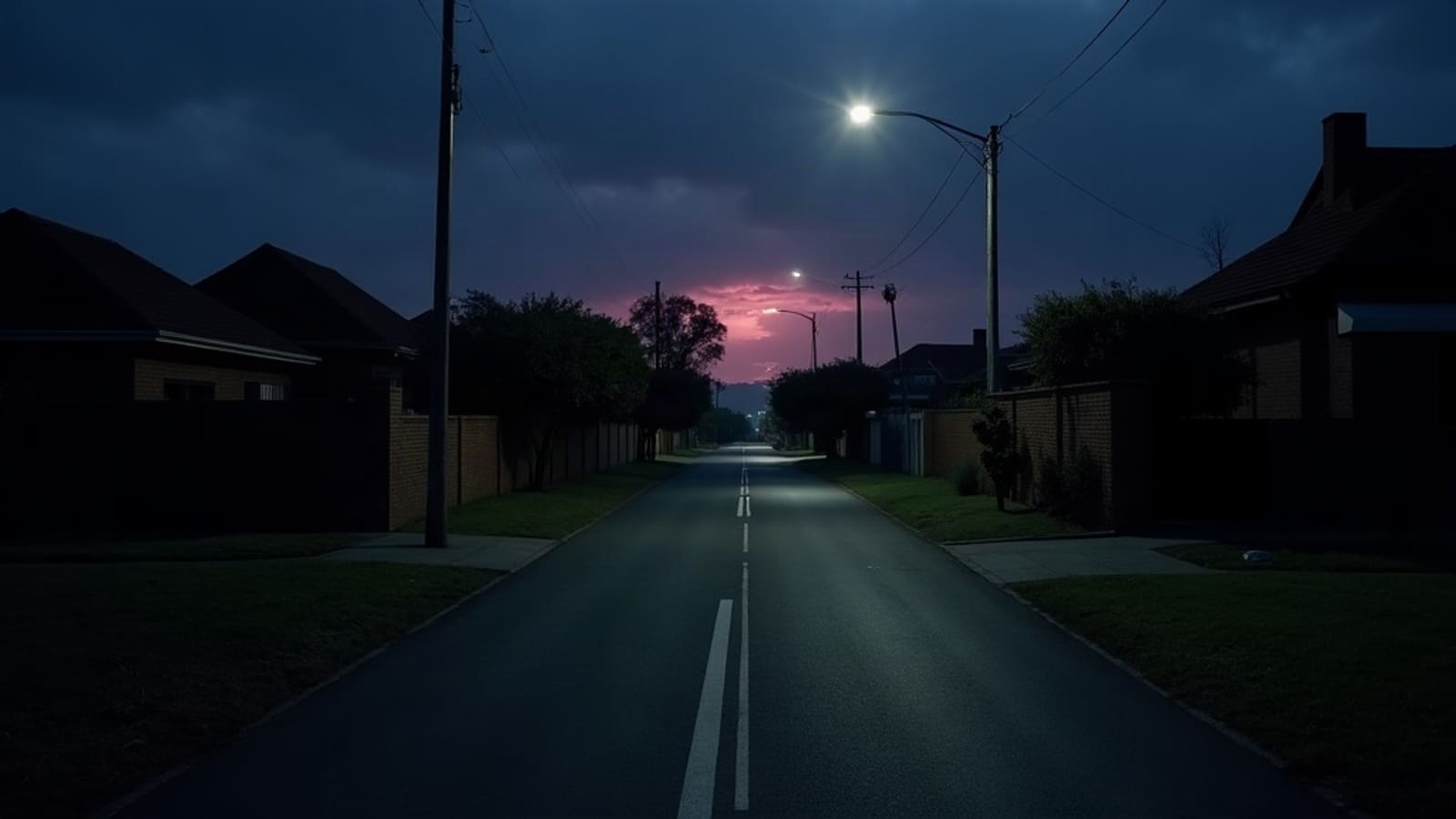
Mindalore is a suburb of Krugersdorp on the West Rand. On a highveld summer night in January 1979, at ten to midnight, Meagan Quezet, a nurse, was reading in her living room while her husband and two sons slept, or were meant to. André, who was twelve, wandered in to say he could not sleep and offered to make tea for both of them. Then the dachshund started up outside.
Cheeky was a dog with opinions, and by the time Meagan reached the gate he was already up the road, with half the dogs in Mindalore agreeing with him. She called André out to help fetch him back, and mother and son walked up Saul Jacobs Street towards the T-junction with Tindall Road, where something was glowing a very bright pink.
Her first thought, she told Cynthia Hind, was that a light aircraft had come down and a nurse might be needed. It was not, she said. The glow surrounded a machine: egg-shaped, metallic, cut off flat near the bottom, with a doorway with two lights either side and one on top. It stood on thin spider legs, about ten centimetres thick, each ending in a sort of sucker pad, and straddled the road, which is about four metres eighty wide. The whole thing was perhaps three and a half metres high.
Then five or six men climbed out of it. Two stayed by the middle of the craft, two went to the far end, and one came towards her. They talked among themselves in a high-pitched language, not Chinese, she said, but something like it. They wore whitish overalls that covered everything but the face, and the one nearest her had pushed his hood back: curly brown hair, a beard, tanned skin, and he was doing all the talking. Then he noticed her. He bowed, said something, and did not take his eyes off her. Meagan said hello and laughed. And then, she said, she was afraid. She turned to her son. “Go and get Daddy, and run, please run.”
What happened next took about thirty seconds. The men jumped back inside. There was a buzzing, like bees. The legs lengthened, the craft lifted off the road, the legs telescoped up into it, it hung there for a few seconds, and then it went straight up and into the clouds.
That is the story Meagan Quezet told awake. Afterwards a well-known Johannesburg psychiatrist put her under hypnosis, and on the tape she describes going aboard with André, and the men wanting her to come with them. Hind describes the woman on the recording as afraid, confused and quite emotional. Many weeks later, with the psychiatrist’s permission, Hind played her the tape. Meagan denied every word, and suspected Hind of hoaxing it for her benefit. Hind’s dry reply in print, two decades on, was that she had not even been in the room.
Hind put the case in her first book, UFOs: African Encounters, and returned to it in UFO Afrinews in January 2000 with a postscript. André had been killed in an accident in his early twenties, during his national service. “I know that both he and Meagan told me the truth,” she wrote. Later retellings add a couple in a car who saw the same thing that night. Hind’s Afrinews account has no such couple. It has a nurse, a boy, and every dog in Mindalore barking at once, and nobody else who came out to see why.
In Cynthia Hind's files
The case file behind this story
- Meagan Quezet and the egg-shaped craft, Mindalore
Cynthia Hind, UFO Afrinews No 21 (January 2000), spread 5
Others saw something near here
The golden ball over the Langham Hotel
Two sisters walking the dog after the cinema heard a thud and saw a saucer with a golden ball hanging over the Langham Hotel, and two tall men watching them.
The hospital that closed on Boxing Day
A 350 bed hospital shut in a day in 1996 with the equipment and files still inside, and the town spent thirty years filling the empty wards with ghosts.
Press report
The morning the police chased a light to Bronkhorstspruit
A pulsing light over Pretoria at four in the morning drew out seven patrol cars and a helicopter. At sunrise it became a white spot. The bill was R4000.

Two constables on the Bronkhorstspruit road
Two policemen said their headlights found a copper disc sitting on the tar. It left in a burst of flame and took part of the road with it.