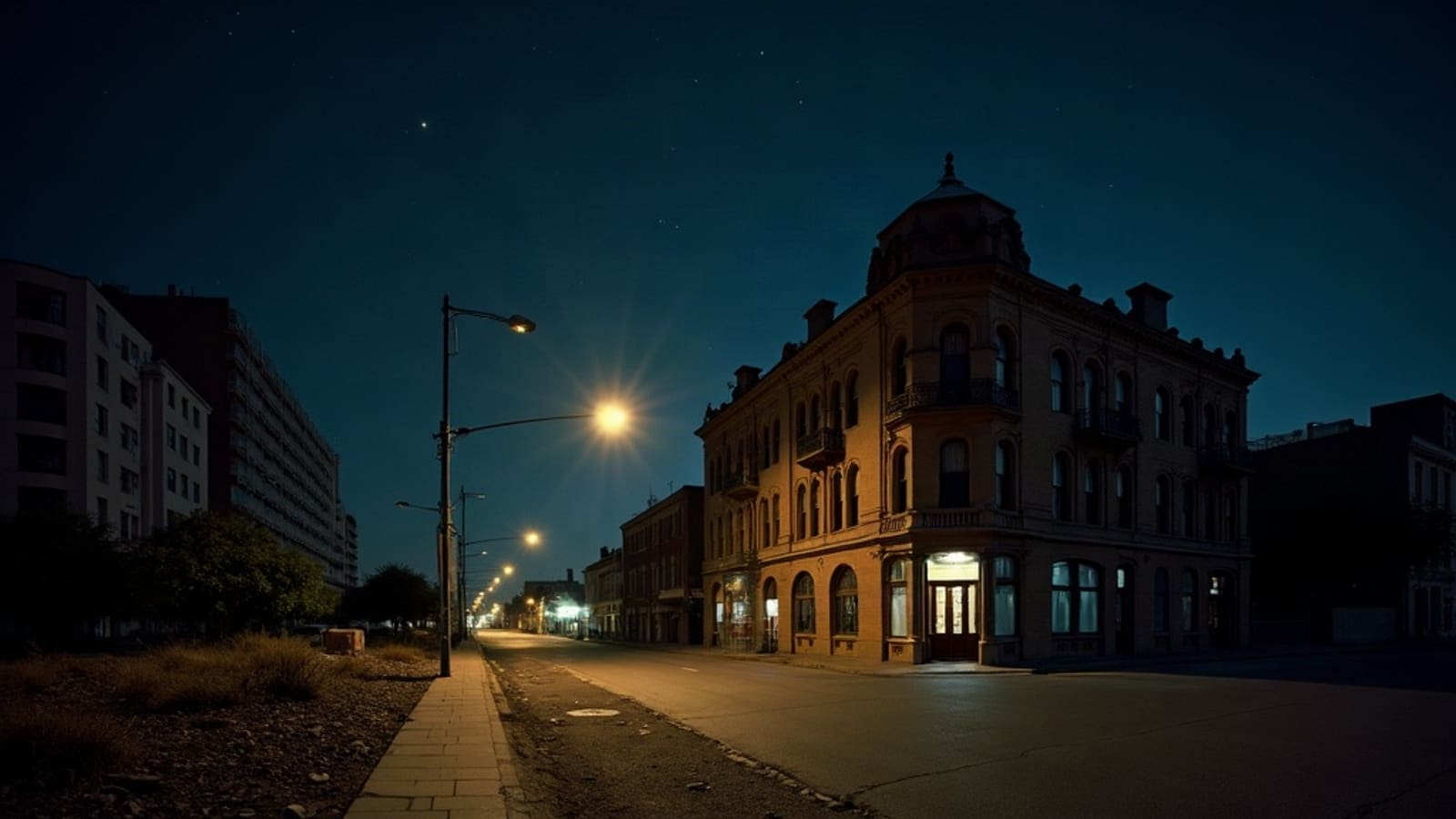
UAP · Delvers Street and the Luthjes Langham Hotel, corner of Kerk and Von Wielligh Streets, Johannesburg, South Africa · 1946
The golden ball over the Langham Hotel
Delvers Street in 1946 was blocks of flats in central Johannesburg, and Vida Goldsworthy had been living in one of them six years longer than she had planned. She had come out from Britain in May 1939 to visit her younger sister, who had married a South African and appears in the record only as Mrs Naudwin. Then the war shut the door behind her. Vida took a government job, Mr Naudwin joined up, and the sisters shared the flat until the summer he was due home.
The account, as Vida gave it thirty-three years later, runs like this. On a warm, still night with the stars out, the two of them came back late from the cinema and took the dog out. Behind their building a house had been demolished and left as waste ground. They let the dog loose onto it and stood on the pavement talking about the film. At about a quarter past twelve there was a loud thud, as if something had hit the ground. They assumed someone had thrown a stone at the dog.
Mrs Naudwin saw it first. Over the Langham Hotel, two hundred yards away, hung something like a saucer, twenty-five or thirty feet across, brownish at the rim and white at the centre, with a bright golden ball set through the middle so that the disc cut the ball in two. It was about fifty feet up, just clear of the hotel roof, and made no sound at all. The sisters took it for some military device, which in 1946 was a reasonable thing to take it for. They lost interest, until they noticed the dog had come back and was sitting at their feet with unusual calm.
Then came a click, and the golden ball dropped down through the saucer, leaving a gap, and stopped level with the hotel roof. There was no visible hole in the disc for it to have passed through. A few seconds, another click, and the ball went back up through the saucer and out the top, where it sat eight or nine feet above the disc on two dark pillars. The pillars gave no light, and Vida remembered seeing sky between them.
The two men were at the base of the ball. Vida described them as identical, about seven feet tall, fair and wavy-haired, “very good-looking”, in white tunics with stiff collars, chest pockets and brownish belts, arms apparently behind them as if leaning on a rail. They never moved. The women felt watched. The object began to turn anticlockwise, and within two minutes it had floated off behind the hotel.
They told nobody, not even Mr Naudwin when he came home. Vida went back to Kent in 1950. In 1979, at seventy-eight, she read a Daily Express series on the subject and told her story to John Judge, whose report appeared in Flying Saucer Review. He could not find her sister. Vida, oddly for two women so close, did not have her address.
Cynthia Hind was sent the report shortly before the February 1998 issue and did what she could from Harare. A 1948 city map from the Johannesburg library put the hotel right: the Luthjes Langham, corner of Kerk and Von Wielligh Streets, not “Langum”, and the flat was more likely Janelea Mansions on Delvers than the spot Vida had marked on Pritchard Street. Hind also suspected Naudwin was a mangling of some Afrikaans name, and said she was trying to check it. She promised to look for the sister’s children and report back. The sister who saw it first was, as far as Hind could tell, never interviewed.
In Cynthia Hind's files
The case file behind this story
- One of the Earliest Recorded UAP Cases: Johannesburg 1946
Cynthia Hind, UFO Afrinews No 17 (February 1998 (cover); masthead printed as January 1998), spread 10-12
Others saw something near here
The hospital that closed on Boxing Day
A 350 bed hospital shut in a day in 1996 with the equipment and files still inside, and the town spent thirty years filling the empty wards with ghosts.
Press report
The egg on Tindall Road
A nurse and her son followed the dachshund up the road near midnight and found an egg on spider legs straddling Tindall Road, with men climbing out of it.

The morning the police chased a light to Bronkhorstspruit
A pulsing light over Pretoria at four in the morning drew out seven patrol cars and a helicopter. At sunrise it became a white spot. The bill was R4000.

Two constables on the Bronkhorstspruit road
Two policemen said their headlights found a copper disc sitting on the tar. It left in a burst of flame and took part of the road with it.