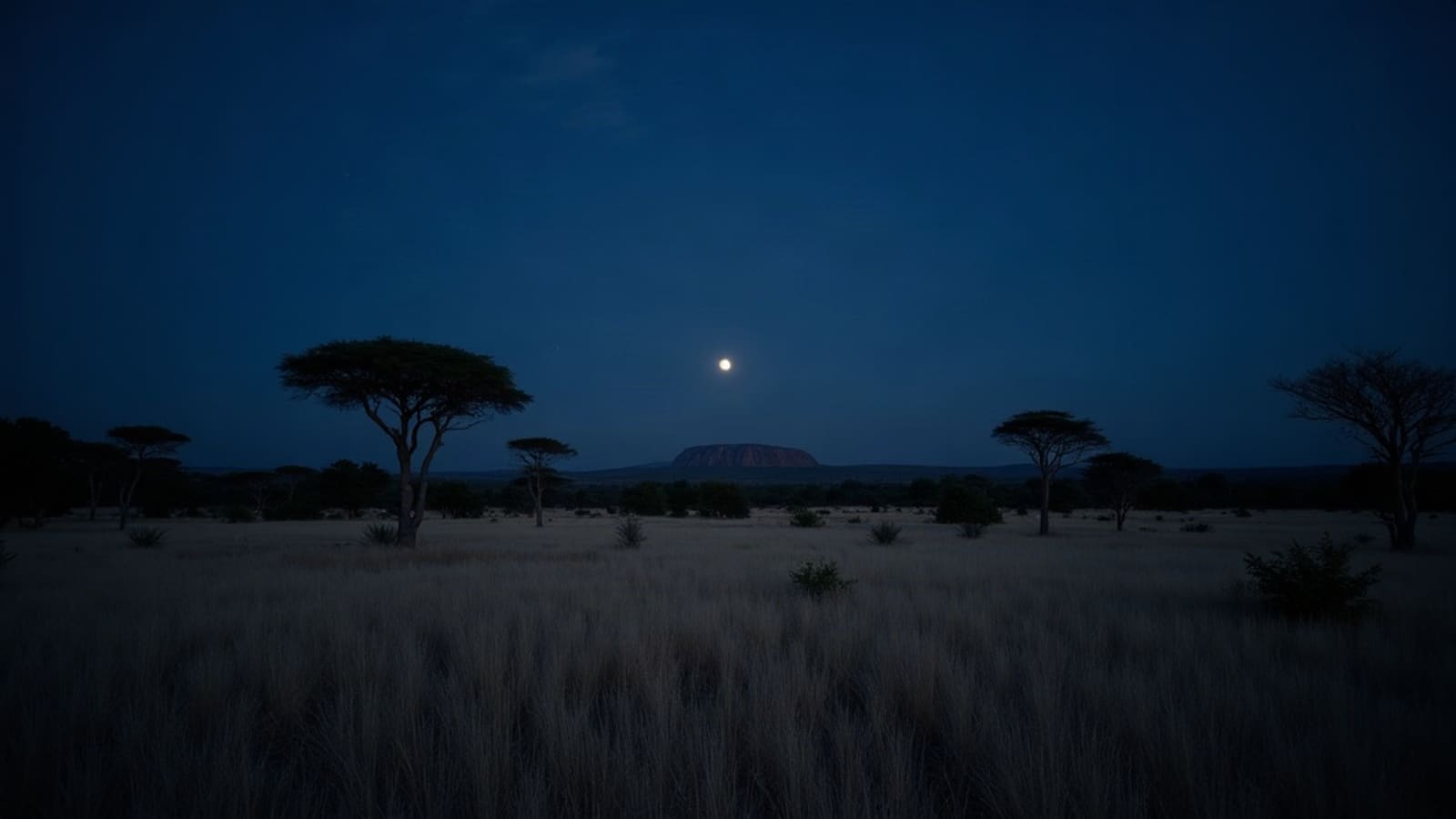
UAP · The lowveld between the Mbizi and Limpopo rivers, south-east of Rutenga towards the Mozambique border, Zimbabwe · 1978
The patrol that stood up at four o'clock
The lowveld south-east of Rutenga is mopane and thorn, flat, hot and thinly watered, running down between the Mbizi and the Limpopo towards Mozambique. In the first months of 1978 it was a war zone, and two sticks of the Rhodesian Light Infantry, eight men, were walking it on a long-range crossgrain patrol, looking for infiltration routes. David Brown, one of the eight, thought that odd. The RLI was Fireforce, a fast reaction force. It did not normally do patrols.
He had a theory about why. A few weeks earlier his stick had been ambushed at night, and he had spent the dark hours half-carrying a wounded man named Twiggs towards the pick-up point. On the way, he said, he saw a shape off to his left against the night horizon: pitch black, no lights, wedge-shaped, perhaps fourteen metres long and four high, some fifty metres off. He asked Twiggs whether he could see it. “Oh no! What is it?” said Twiggs. The word went down the line, and the line kept walking. At the bush base the Major had Brown describe the thing and draw it, then dismissed him. Nothing more was said. Then came the unusual patrol. “In other words,” Brown wrote, “they found us before we found them.”
The patrol was routine until the midday halt, an hour in the worst of the heat. When Brown got up to move on he looked at his watch, and it said four o’clock. He put on his bergen. As he did, he said, a flash of light hit him from an object hanging just above the trees about a hundred metres away, metallic, elliptical, silent. Then it shot off at a speed he could not credit, without a sound. He was a soldier in a combat zone and he did nothing: no warning, no question to the man beside him. Nobody else said anything either, not then, not later, not ever. By his watch, three hours had gone somewhere, and eight men walked on as if they had not.
For years he had only that flash at the back of his mind. Then, he said, the pictures started, and he wrote each one into a diary as it came: a hooded dwarf leading him to a clearing where a ship stood; a double of himself in a blue cloak, glowing and fading; a crescent-shaped ward with a long line of beds and his comrades in them; a reptilian thing that took him by the throat; a white ribbon pushed through a wound in his side that drank his blood and stayed white; a power station where his watch stopped. He insisted the diary came before the television documentary that made him suspect what kind of story he was in. Hind wondered whether it was the Intruders film, built on Budd Hopkins’ cases.
Hind took the case up by letter in the 1990s and found a man in his late forties who wanted no publicity and nothing for himself, only an explanation, and whose devout wife did not accept a word of it. She had dozens of questions and was careful to ask none that led. She suggested hypnosis and was told he was not ready. She was convinced he was honest, and said so.
One image she would not let him drop. In it he finds an abandoned baby wrapped in white cloth, propped in a corner, with a face half fish, half human, and half a loaf of bread beside it. Brown suggested leaving the bread out, since it made him laugh. Hind’s answer, in a footnote, is three words and an exclamation mark: “I think not!” Every scrap of evidence, she added, means something in a case this tangled.
In Cynthia Hind's files
The case file behind this story
- Soldier in Distress: the crossgrain patrol abduction and flashbacks
Cynthia Hind, UFO Afrinews No 16 (July 1997), spread 05-10