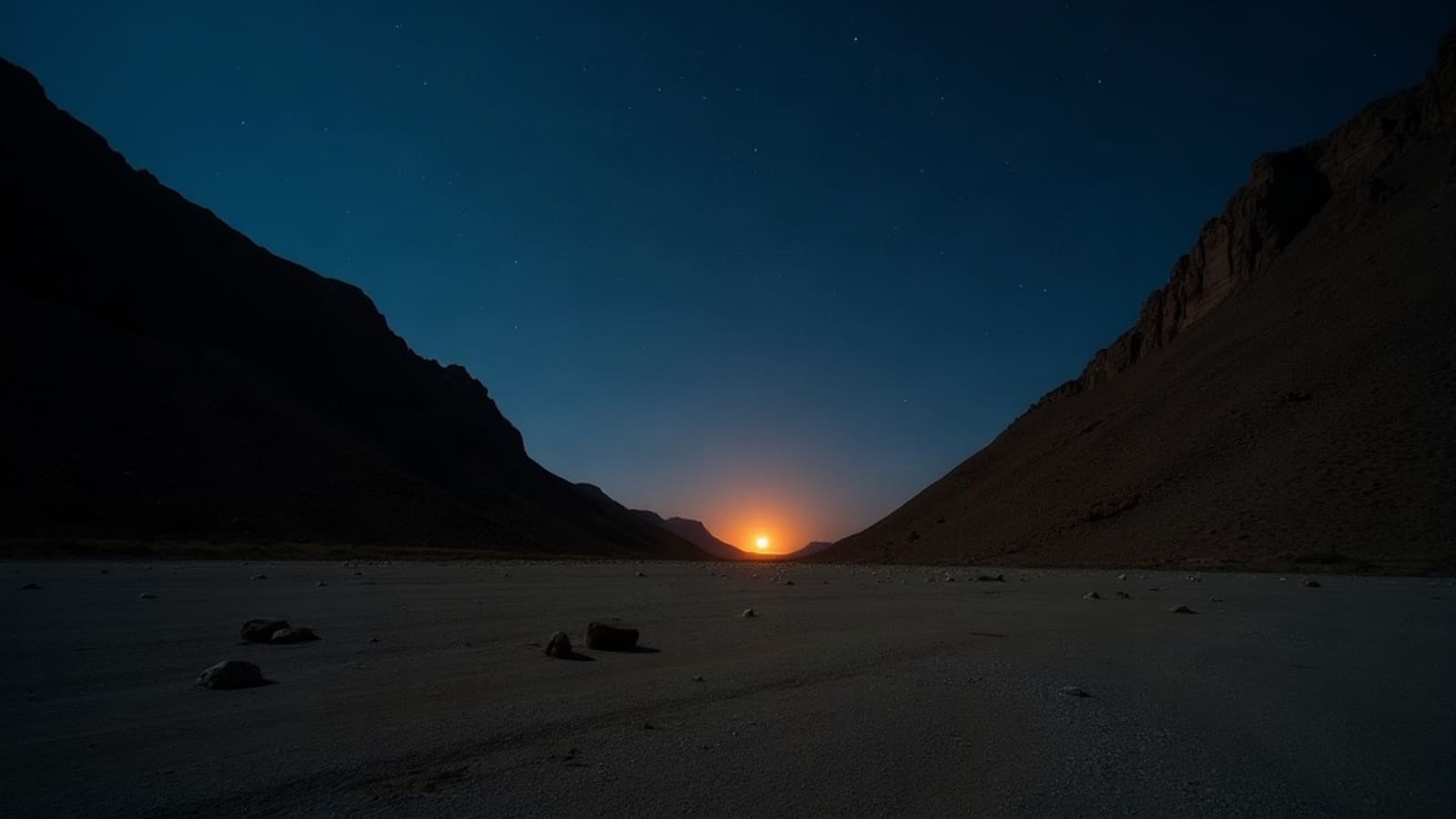
Other · Geologists' base camp in the Namib, near the Swakop river bed, Namibia · 1970
A curtain of fire in the Namib
The Namib at night has two qualities: the dark is complete and the silence is total. In 1970 a boy the magazine calls Hein, later of Kuils River, lived in both, in a geologists’ base camp in the middle of the Namib, among stony hills that ran down to the dry bed of the Swakop river, and went to school in Swakopmund. His father was a geologist at the new Rössing uranium mine.
One weekend the scattered camps gathered for a braai at Hein’s: parents, children home from boarding school, at least twenty-five or thirty people under a clear sky. Between nine and ten, after the meal, it was “as if someone had switched on lights”.
That is how Hein put it to Pam Puxley when she taped him on 1 February 1993. A hill ran down either side of the camp towards the river bed, and the two did not meet: between them was a gap two rugby fields wide, an open V. In that V, from one instant to the next, stood a mass of flame. It was as high as the hills, he said, about eight storeys, and from side to side it closed the gap like a stage curtain, except that the curtain was fire, flickering and the ordinary colour of fire. Everyone could feel the heat.
The children screamed, Hein among them, and he had, he noted, a great voice at that age. The women screamed. One of the men became a bit hysterical. It lasted three minutes, or five, or what felt to an eleven-year-old like a very long time, and then it was gone as if the switch had been thrown back.
The men fetched their firearms and went up to the gap in Land Rovers and bakkies. They found nothing: no tracks, no vehicle marks. The women sent them out again. Hein remembers his mother shaking too hard to make the tea, and another woman telling her, “Forget the bloody tea, give me a brandy!”
At first light the whole camp walked up to the V. No burnt grass, no darkened sand. Somebody proposed a prankster pouring fuel down the hillside, so they poured a little on the ground and lit it: the sand discoloured at once. Where the wall had stood there was nothing: no containers, no footprints.
Or rather, no footprints there. By a small tool shed at the bungalows, Hein found a line of tiny prints in the sand, heel pressed deeper than toe, five centimetres long, the tracks of something the size of a large doll, walking. They went into the shed and did not come out. His sister’s teddy bears did not fit them. The camp cats, normally lap animals, spent the next week or two close to the huts, eating with their heads up like frightened buck at a waterhole. His own cat, Spykerkie, who followed him like a dog, would not go anywhere at all.
Cynthia Hind printed the account in UFO Afrinews in 1993 while saying plainly that she saw no UAP connection in it; the footprints earned it a place. She set beside it a Colorado report from about 1930, from William Corliss’s sourcebook, of a curtain of fire rising off a mountain ridge, and offered, without much conviction, methane erupting and igniting on contact with the air. Why it should happen as it did, she wrote, remains the mystery.
The same day Hein gave Pam Puxley a story of his mother’s as well: a horse ride near Bethal in 1948 or 1949, printed straight after this one as Case No 72.
In Cynthia Hind's files
The case files behind this story
- Wall of flame between outcrops in Namibia
Cynthia Hind, UFO Afrinews No 7 (January 1993), spread 24 - The Wall of Flame
Cynthia Hind, UFO Afrinews No 8 (Sept. 1993), spread 13-15
