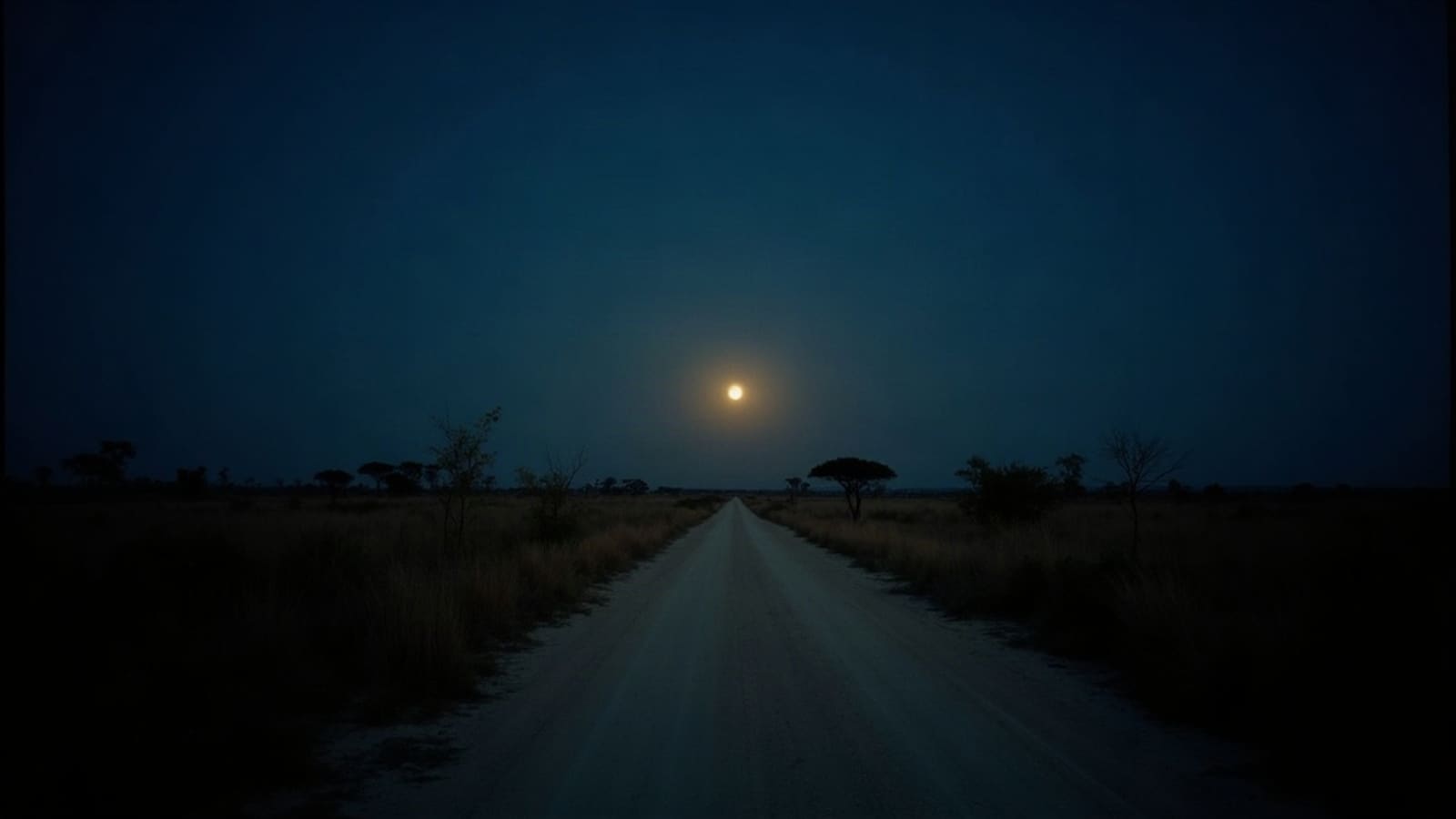
UAP · Outside Lusaka, and a farm road in Southern Province, Zambia · 1985
The night visitors outside Lusaka
The moon was full, the coffee was hot, and the bush on either side of the road had gone completely quiet. That is how Dimitri put it when he wrote to Cynthia Hind thirty years later: no crickets, no wind in the trees, nothing moving in the dark. Three people stood beside their vehicle on the road north from Zambia’s Southern Province, before four in the morning. The farm lay some three hundred and thirty kilometres from Lusaka, where the family’s tobacco went under the hammer that morning.
It was May or June 1968 and Dimitri was about twenty. His Greek parents had come to Zambia from Tanzania the year before to grow tobacco, and he was travelling with his father and his father’s wife. Looking up at the moon, they thought they had spotted one of the American rockets on its way there. Then, he said, the thing that had seemed very high up was suddenly quite close, under a mile off. It was bullet-shaped, a little longer and taller than a Boeing 747, and in the moonlight it shone like silver. No lights, no wings, no tail, no exhaust, no sound at all. It crossed from east to west more slowly than a jet. They watched for some time; he could not say whether it reached the horizon or simply faded. Then they drove on, because the floors would not wait.
They talked about the rocket the rest of the way. In Lusaka they never mentioned it again. (For the record, nothing American was bound for the moon in May or June 1968. Apollo 10, the flight the report wonders about, flew a year later.)
In 1982 or 1983, living outside Lusaka, Dimitri woke abruptly in the early hours, breathing hard, flat on his back, with what he described as a rat-like face almost on his own, puffing at him in the dark. Oddly, what followed was a feeling of security, and he slept again. That happened twice.
The third time, some night in 1985, he woke and could neither open his eyes nor move. He reached for his watch and the arm was dead. He could hear, he said, hundreds of cattle hooves running, and then a metallic tak, tak, tak, over and over on the corrugated iron roof. He was certain his cattle were being stolen and could do nothing. When the noise stopped, and only then, his eyes opened. Dark, silent, and once more that unaccountable calm. He slept.
Hind adds a note. The family kept six Alsatians inside the house precisely so that a bark would wake him. On none of these nights did a dog make a sound.
Then there is the lump. Below the left lens of his glasses Dimitri had for years a small, hard, brownish cyst about two centimetres across, the kind his countrymen, he said, call olives. One night, shortly before he wrote, he found it loose under his fingers and left it alone in case it bled. By morning it was gone: no lump, no blood on the pillow, nothing. In the mirror, where it had been, was a razor-thin line a centimetre long, almost the colour of his skin.
Since July 1996, he added, he had been seeing many strange lights in the sky.
Hind was candid about her difficulty: one continuous experience running from a silver bullet on a farm road, or a man stretching his wish to be involved? From his letters she could not push him aside, and filed him as a case to watch. The newsletter had three issues left to run.
Others saw something near here

Nyaminyami and the dam
The Tonga said the river god would not stand for a wall across his gorge. Then the worst flood on record came, and the year after, a worse one.
Press report
Lights over Kariba
Two nights before Ariel School, a fireball with a tail crossed the whole country. In Kariba, people said it stopped and hovered.