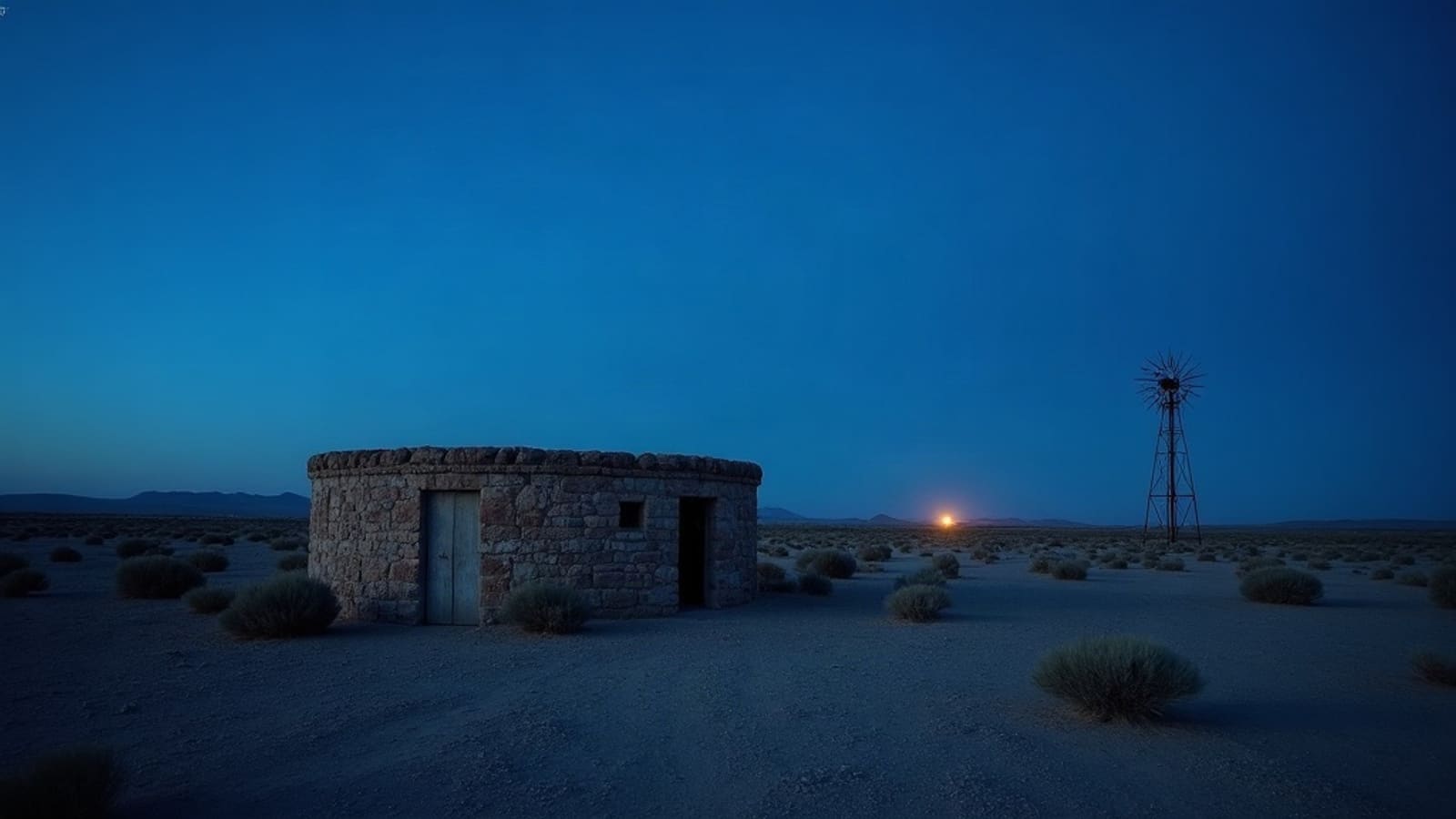
UAP · Loxton, Northern Cape, north of Beaufort West, South Africa · 1975-07-31
The caravan in the kraal at Loxton
Loxton sits in a fold of the Karoo north of Beaufort West, with its water reservoir on the hill above the village. When the winter rains were heavy the reservoir spilled and the overflow came down through the houses, so the villagers built a wall around the place, about three metres high, and lived behind it. Danie van Graan’s sheep kraal lay on the far side. Early on 31 July 1975, around half past seven, he climbed the wall to check on his animals and saw a caravan standing among them.
That did not alarm him. Government teams had been surveying the district for uranium, and they worked out of caravans. His first thought, as he later told Cynthia Hind, was that he might cadge a cup of hot coffee.
The closer he got, the less it looked like a caravan. It had no wheels: it stood on tines. Its windows were far too large, and through them he could see four short men in tight-fitting suits with the hoods thrown back. Their eyes were slanted, “like the Russians (Mongolians)”, he said. Three were bent over something like a microscope. The fourth stood at a console of flashing lights. None of them took any notice of him.
Then, at about five metres (three, in an earlier telling), all four looked up at once, as though he had tripped something. He heard a click. A small shutter opened, he said, and a strong beam of light hit him full on.
“I felt as though I was drowning”, he told Hind. His only idea was to get out of the light, and as he staggered clear, he said, the thing rose and went, very fast, so low that it nearly took his windmill with it. He fell against the kraal fence, vomited, and found his nose was bleeding.
Hind wrote the case up in her 1982 book and kept citing it for the rest of her life: for physical effects, she said, it was the best she ever handled. The Loxton police photographed the ground where the machine had stood, and she kept the prints. In the hard winter soil were five distinct tine marks, four arrow-shaped indentations around the edge, and a criss-cross imprint at the centre with a small heap of grey-green granules in it. For about eighteen months a circle two and a half metres across grew nothing at all. Nobody, she said, had ever sent her marks like them from anywhere else.
Van Graan did not recover. He had conjunctivitis for a while and double vision. “He was never the same man again”, Hind wrote. He died in hospital riddled with cancer: within a year or two, according to one issue of her newsletter; on 4 January 1981, more than five years later, according to another. Of all the African cases she handled, she wrote, this was the only one that ended so badly.
The click is the detail she kept returning to. Van Graan heard it once, at the instant the beam struck, and she collected the same small sound from other witnesses, one of whom compared it to a key turning in a lock. She came to wonder whether the click marked the moment something switched on in the witness rather than in the machine, and was careful to leave it at maybe.
The granules went to the Geological Survey, which found them to be mostly a mineral Hind’s report calls thaumacite, and noted that it was of no commercial value. That appears to have been the only question anybody put to it.
In Cynthia Hind's files
The case files behind this story
- The Click Sound: Danie van Graan at Loxton
Cynthia Hind, UFO Afrinews No 7 (January 1993), spread 11 - Danie van Graan, Loxton: the two-metre dead circle
Cynthia Hind, UFO Afrinews No 10 (August 1994), spread 05 - Danie van Graan at Loxton (editorial recap, slow motion)
Cynthia Hind, UFO Afrinews No 16 (July 1997), spread 03 - Danie van Graan, Loxton, 31 July 1975 (radiation effects recap)
Cynthia Hind, UFO Afrinews No 17 (February 1998 (cover); masthead printed as January 1998), spread 8-10 - Danie van Graan and the caravan without wheels, Loxton
Cynthia Hind, UFO Afrinews No 21 (January 2000), spread 3-4