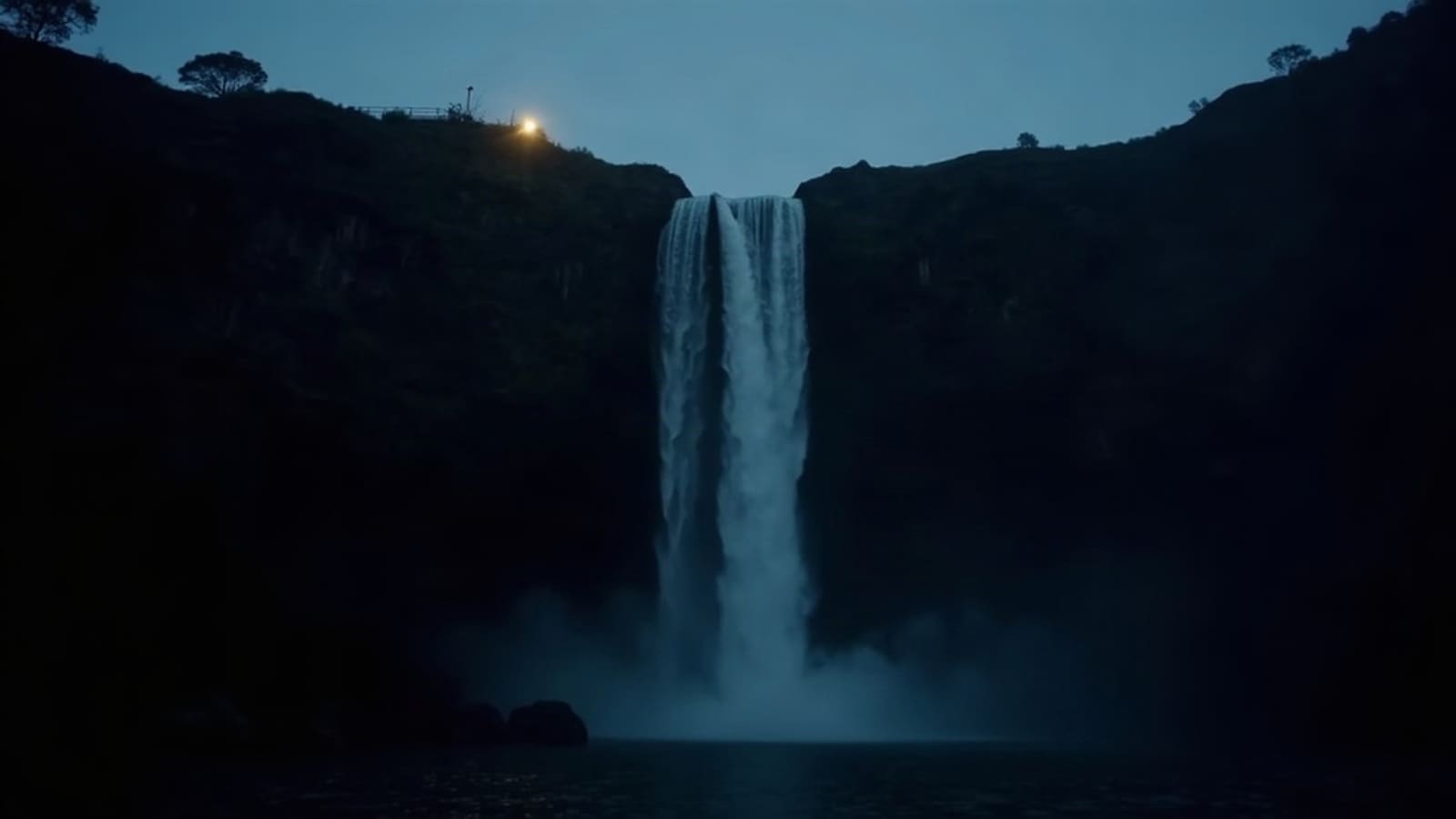
Cryptid · Howick Falls, on the Mngeni River in the KwaZulu-Natal Midlands, South Africa · 1995
The serpent of Howick Falls
The Mngeni River drops 95 metres at Howick in one straight fall, into a pool that is a good deal deeper than it looks. The town grew up around the top of it, and the viewing platform is a short walk from the shops. On a still afternoon the spray hangs over the pool and the cliff behind it is black and wet. It is exactly the sort of place a story needs.
The Zulu name for the falls is KwaNogqaza, the place of the tall one, and the tall one is the inkanyamba. In Zulu tradition the inkanyamba is a vast serpent of the rivers, with a head most tellers describe as a horse’s, that lives in deep pools under waterfalls and rises into the sky in summer to look for its mate. When it travels it takes the weather with it. The great storms that strip roofs across the Midlands are the inkanyamba on the move, and hail is its temper. The pool at Howick is held to be one of its houses. Sangomas go down to the water to make offerings there, and by custom it is only they who may approach the pool safely. Everyone else stays on the platform.
So the sightings, when they came, did not come out of nothing. In 1962 a ranger with the provincial conservation service named Buthelezi said that he and a friend had come upon a horse-headed animal with a long body lying on a sandbank upstream, near where Midmar Dam is now, and that it slid into the river as they approached. In 1971 and again in 1981 the caretaker of the caravan park at the falls, Johannes Hlongwane, said he had watched something raise its head and neck high out of the pool, with a crest running down its back. Then in September 1995 a Howick restaurant owner, Bob Teeney, said he had seen a snake-like head rear up out of the water while he was standing on the platform. He had no camera with him, which he regretted, so he put up a reward for anyone who could get a picture.
A picture duly arrived. It showed a long neck rising out of dark water with what looked like weed in its mouth, and for years it was printed and reprinted as the only photograph of the inkanyamba in existence. It was eventually identified as an illustration of an Apatosaurus from a 1970s children’s book of dinosaurs, held up in front of the falls.
The anthropologist Sian Hall, who has written about the Midlands, has called the modern monster folklore with tourism added, and the sober explanations line up neatly enough: a big eel, a crocodile, a standing wave in the wrong light. None of that touches the older belief, which was never about a creature you could photograph. The inkanyamba is the reason the storms come, and a reason to be careful at the water.
The pool is still there, still deep, and still nobody’s idea of a swimming spot. The reward, as far as anyone knows, was never paid.
Others saw something near here

Charlotte of Nottingham Road
Guests in Room 10 wake to find their clothes folded and the taps running. The hotel says that is Charlotte, and she means well.
Press report
Flying Saucer Hill
A Rosetta farmer's daughter said a ship came down on a hill above the Mooi River, and that its pilot took her to the stars and gave her a son.

The tokoloshe
Short, hairy, fond of rivers and mischief, and the reason a great many beds in southern Africa stand on bricks.
Folklore
The light that hung over Durban
A Phoenix woman woke her husband to film a pulsing ball of light that changed from round to oval and stayed three hours, until the sun came up.