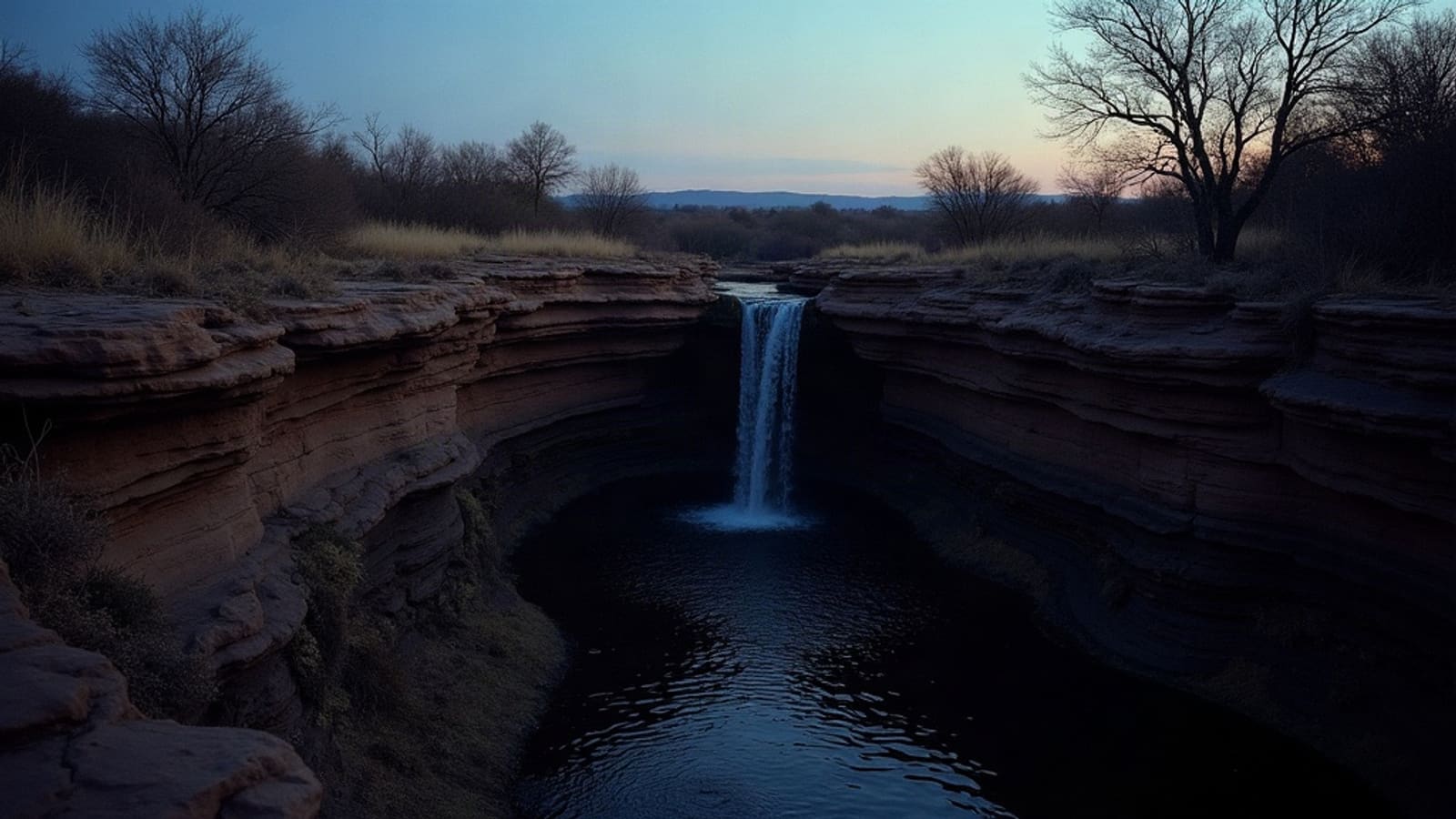
Folklore · Kgosupo gorge above Maunatlala, and the Goo-Moremi gorge, Tswapong Hills, Botswana · 1987
The rain snake of the Tswapong Hills
The Tswapong Hills stand up out of the flat bush east of Palapye, a long sandstone ridge full of gorges that hold water when nothing around them does. Springs run down through pockets of forest to waterfalls and pools, vultures nest on the cliffs, and the villages that ring the hills have looked up at them for centuries as the place where the rain is decided. In the gorges, the people of the hills say, there are snakes that are not snakes.
The word is kgwanyape. In Setswana tradition it is a great serpent of water and storm, cousin to the inkanyamba of the Zulu and the khanyapa of the Basotho, and it lives in pools and gorges and is not to be disturbed. The one everybody around the northern side of the hills knows about lives at Kgosupo, a gorge in the hill above the village of Maunatlala. When the kgwanyape is angry it does not bite. It sends wind, and the wind does not stop.
In 1987 it did not stop for more than a week. Maunatlala was hit by gales that tore thatch and roof sheets off houses and brought down trees, and when the village asked why, it had an answer ready. A teacher at the secondary school, a foreigner known in the village as Thotha, had been walking in the hills. He had gone up to Kgosupo, the story went, and found the serpent’s young, and taken them away with him, and this was the serpent looking for them. Nobody seems to have asked the teacher about it in print, but the wind did in the end drop, and the story did not.
Along the ridge, the village of Goo-Moremi sits at the mouth of the finest of the gorges, three waterfalls one above the other in a cleft of the hills, and the gorge is the home of the badimo, the ancestors of the Bapedi people who settled here. It is a national monument, and on Botswana’s list of candidates for World Heritage. The shrine in the village, the Komana, is kept by elders who alone speak to the ancestors, and the ancestors, the tradition says, control what happens in the hills, in particular the rain, the fertility of the fields and the harvest. Visitors go into the gorge only with a guide from the village, and only after agreeing to the rules: no whistling, no shouting, no alcohol, no flash photography past a certain point, and permission from the headman first.
The gorge has its own snakes, and its own stories about them. When the government first sent crews to build a road into Goo-Moremi, and later to sink a borehole, the work stalled and stalled again, and the villagers explained why: the workers had come without asking the hills, and the serpents that stand for the gods of the place would not allow it until the proper approach was made. The 2006 Mmegi article that set down the Maunatlala story recorded these too, alongside serpent traditions from villages across the east of the country, and pointed to the python carved into the rock in the Tsodilo Hills, in the far north-west, which archaeologists had that year dated to some seventy thousand years ago. The snake, on that reading, might be the oldest god the country has.
The kgwanyape at Kgosupo has not made the news since 1987. The wind still gets up over the Tswapong Hills every spring. People in Maunatlala know the difference.
