USO · Gomaub-South farm, Hoachanas district, Hardap, Namibia · 1985-04-26
The dam that emptied overnight
Around midnight on a dry, windless, cloudless night at Gomaub-South, a farm in the thorn country around Hoachanas in southern Namibia, a twelve-year-old girl woke with a fever and went with her mother to find medicine. What the two of them saw from the house, as Hannetjie described it six years later, was a round ball of light, bigger than a motorcycle headlamp, coming up from the south and passing away to the north. It was not blue-white. It glittered, she said, like the stars do, as though it held a thousand tiny ones, each brightening and going dark in turn. Her mother called it blinking. There was no sound. The dogs, she said, were at their quietest.
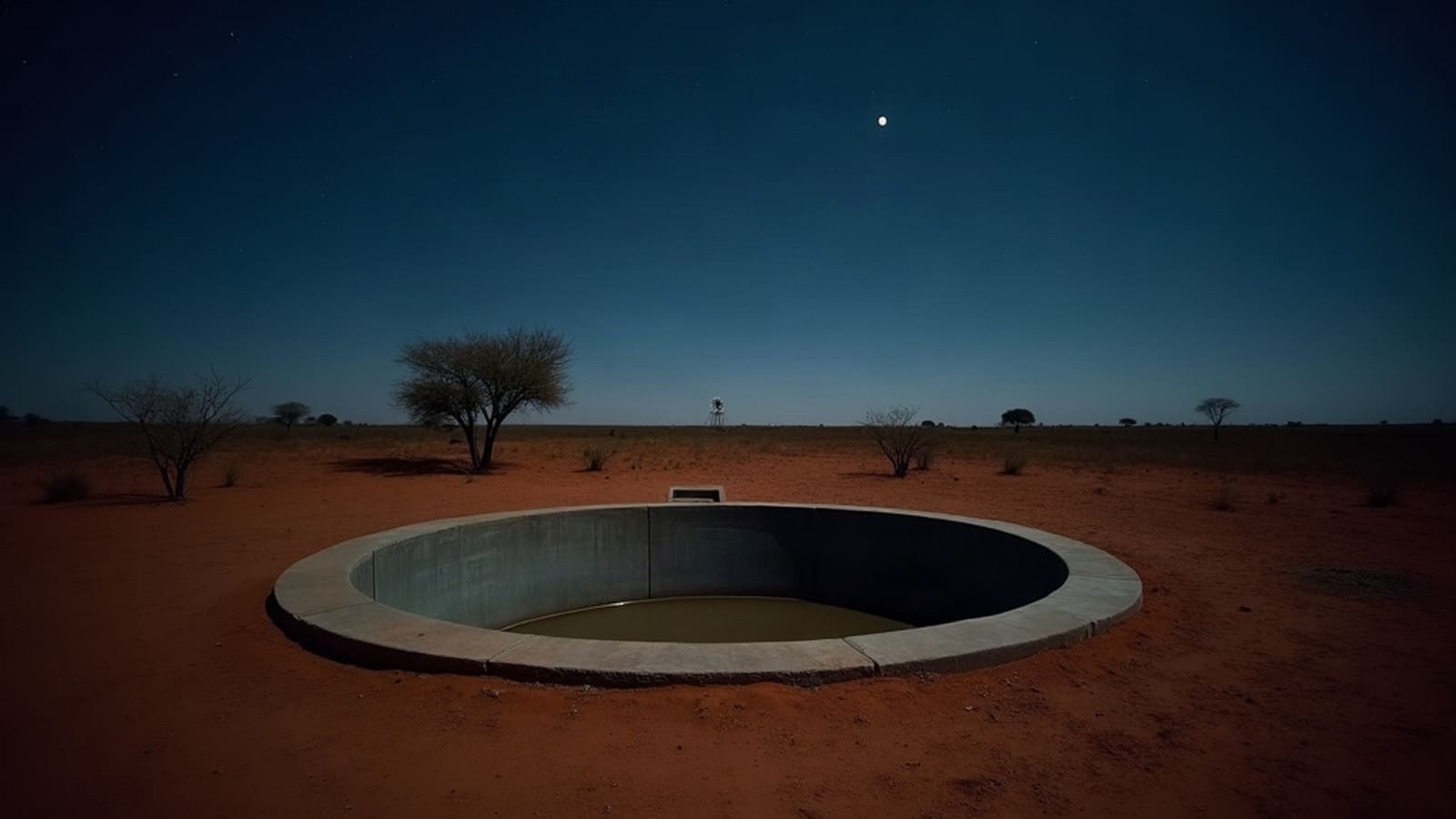
In the morning her father, Mr V., who had farmed that ground since 1932, went down to the Lower Dam and found it empty. The dam was about fifteen metres across with sides two metres high, and it did not leak: this was the second time in five months, he said, that it had lost its water overnight. He added, without fuss, that he had several times watched what he called a “spooky light” cross the farm and go. “It’s the size of a large motor-bike headlight,” he said.
That was the whole report when Cynthia Hind printed it in 1991, sent in by her Namibian correspondent R. M. Roeis. She used it to open a short review of water cases: the Fort Beaufort dam that shattered twelve days after Bennie Smit fired at a ball of fire, a corrugated iron tank in Natal that drained overnight, and Henry at Du Toit’s Kloof carrying stream water into a craft. Paul Norman, a colleague in Australia, was collecting reports in which UAPs seemed to need or use water, and Hind thought Namibia belonged in the file.
The second instalment came a year later, when Roeis tracked down the daughter, married by then and living in Mariental. The first report had said Mrs V. was woken by her child crying in its cot, which left everyone picturing a baby; Hannetjie was twelve and remembered the night in detail. She also supplied the piece that turns a dry dam into something stranger. The next day, at about two in the afternoon, one of her father’s farmhands, out guarding the sheep, came to the homestead to say that a red ball had “drunk” the water from the Lower Dam. Hind read that as a man who had watched the water go; Hannetjie only says he came in and said so. The herder also told them, she said, that the sheep refused to go near the camp where he had seen the red ball.
Hind set out the discrepancies with care. The girl saw a starry ball that was not blue-white; the farmhand saw a red one; Hannetjie herself was not definite about the colour, and Hind promised to check. She was willing to hear that balls of light might be ball lightning or plasma, but wanted to know how either could absorb the full contents of a dam. And she was clear about who mattered most: the sheep-guard, the only person who claimed to have seen anything happen at the water, and Roeis must find him. A further report was promised.
Mr V. died in 1987, two years after the newspapers ran the story. The dam, as far as the newsletter records, went on being a dam. Hannetjie remembered that the day after the light was a Monday. The date printed in the first report, 26 April 1985, was a Friday.