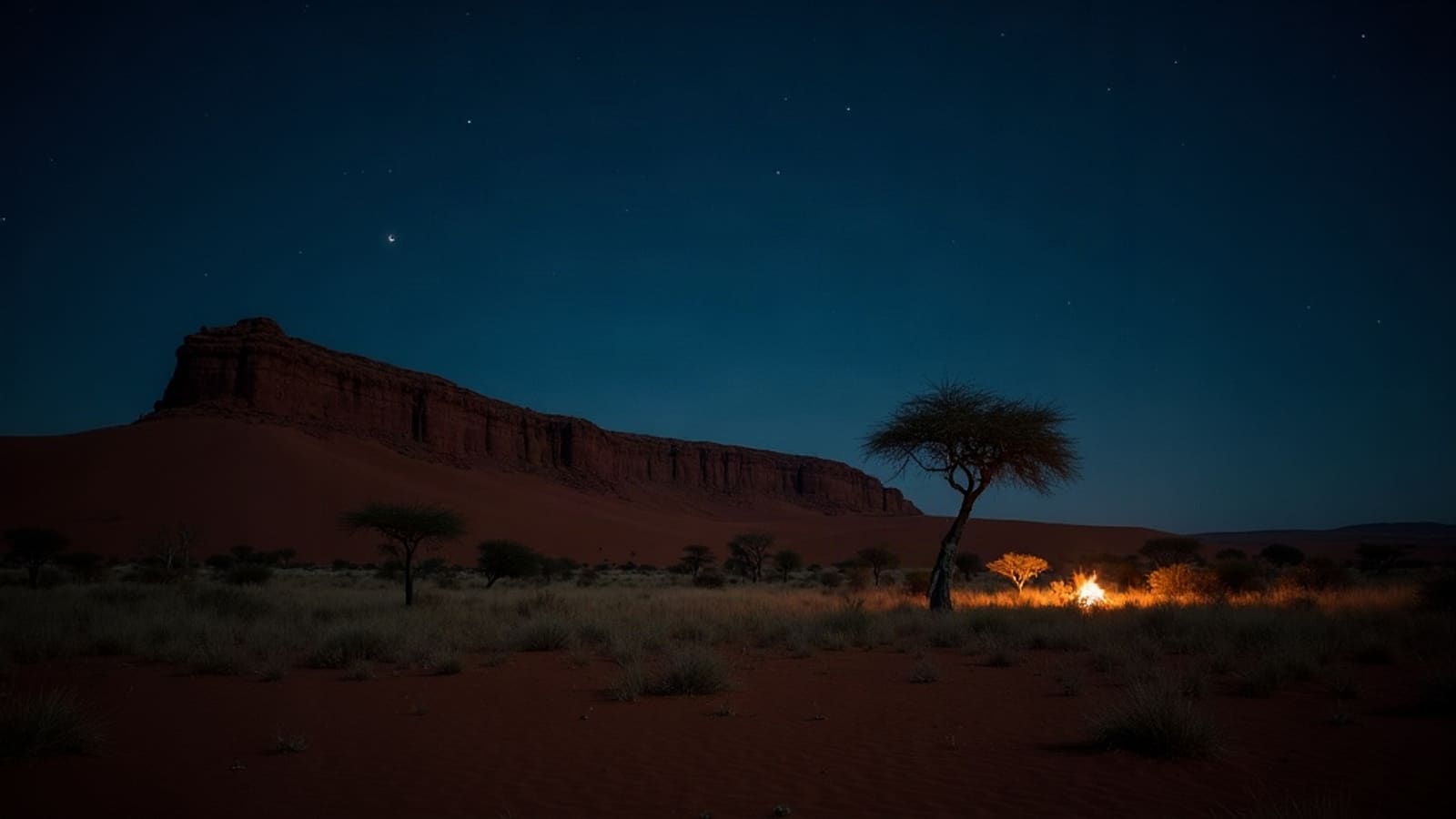
Other · Eierdop Koppies near Rietfontein, on the Namibian border in the Kalahari, South Africa · 1885
Farini's Lost City of the Kalahari
Late one afternoon in 1885, somewhere in the southern Kalahari, a wagon party stopped beside a long low ridge of stone that did not look like the rest of the desert. The leader of the party got down and walked its length. He saw courses of dressed rock laid in straight lines, a pavement, what might have been the base of a wall running for a mile and more, and blocks so square and so regularly stacked that he could not see how the wind had done it. His son took photographs. Then they moved on, because water was short and the ruins, whatever they were, were not going anywhere.
The leader was William Leonard Hunt, better known on three continents as The Great Farini: tightrope walker, the man who had crossed Niagara on a wire with a washing machine, impresario of human cannonballs and the Earthmen of the Kalahari, whom he had exhibited in London the year before. The exhibition gave him the idea of seeing where they came from. He went out with his adopted son Lulu, who was the photographer, a Cape guide named Gert Louw, and a wagon, and in six months crossed a stretch of the desert that no white traveller had written up before.
Back in London he read a paper to the Royal Geographical Society, put Lulu’s pictures on show, and published a book, Through the Kalahari Desert, which is a good read and not always careful. The ruins got a few pages and a poem. Farini thought he had found the remains of a city, built by people long gone and half buried by the sand, and he said so in verse.
That was enough. For the next eighty years South Africans went looking for it. By 1932 there had been twenty-five expeditions; by the 1960s the count was past thirty. They went on camel, on foot, by truck and, once aircraft were available, from the air: a Kimberley journalist and a doctor flew search patterns out of Upington in the 1930s, and in the 1950s a Pretoria chiropractor named Joshua Haldeman made repeated flights over the Kalahari in his own plane looking for it, a hobby his grandson Elon Musk would later mention in interviews. Nobody found a city. The trouble was Farini’s route, which he described in a way that could not be reconciled with the map, and his distances, which were cheerful.
In 1964 a Cape Town writer and amateur geologist, A. J. Clement, sat down with the book, the RGS paper and the photographs and worked out where Farini had actually been. The answer was the Eierdop Koppies, the eggshell hills, a short way from the settlement of Rietfontein on what is now the Namibian border. Clement went there. He found long ridges of dolerite, a volcanic rock that cools into blocks and columns with flat faces and right angles and that weathers, over 180 million years, into something that looks very much like a ruined wall. Lulu’s photographs matched. There was no mortar, no tool mark, no pottery, and no city. Clement published the finding in the South African Journal of Science and, three years later, in a book.
That ought to have been the end of it. It was not, quite. Farini’s book was reprinted, television crews have visited the koppies, and every few years somebody proposes that Clement found the wrong rocks. The desert, for its part, has kept the pavement exactly where it was.