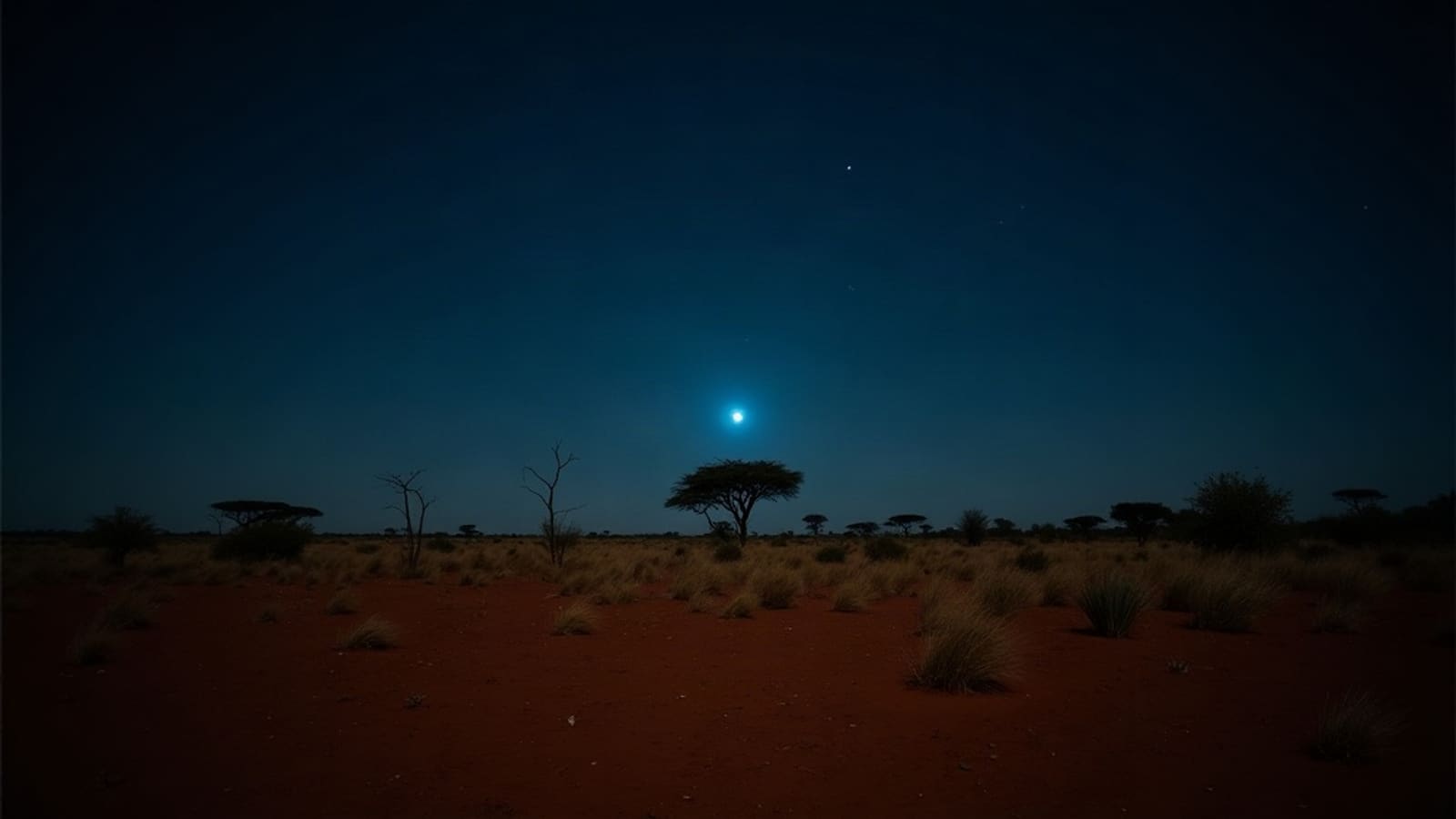
Lights · Farm road in the Epukiro district, Omaheke, eastern Namibia, Namibia · 1980s
Die spook van die Kalahari
Epukiro is cattle country on the Namibian side of the Kalahari, east of Gobabis, where the farms run to the Botswana line and the roads between them are two ruts in red sand. In the middle of the 1980s a young woman who worked as an analytical chemist in Windhoek drove out there most weekends to see her fiancé on his farm. One Monday morning she came back to town shaken and did not want to talk about it. Eventually she did, and years later the story reached Roland Roeis, the Namibian correspondent of Cynthia Hind’s UFO Afrinews, who printed it in 1996 with the witness’s initials and nothing else.
On the Saturday night the couple had been to a braai on a neighbouring farm and were driving home late in the fiancé’s small truck. It was calm, clear, a moon and stars, spring or autumn. She was dozing. She woke because he had braked, hard enough to throw her forward, and when she looked at him he was sitting quite still with one finger pointed through the windscreen.
About three hundred metres ahead, over the road, was a ball of light. It was, she said, about the size of the headlamp on a big motorbike, bluish-white and very bright against the night, and it was moving slowly across the veld at a height of two or three metres, rising and dipping so exactly with the ground that it seemed to be following the contours of the land, as far as either of them could make the contours out. They sat and watched it for what she estimated at ten minutes. Then it was gone.
What struck her most was not the light but her fiancé’s reaction, which was calm. He said it was about the second time he had seen it. The farmers round Epukiro, he said, called it die spook van die Kalahari, the ghost of the Kalahari, and saw it fairly often, and had stopped remarking on it.
She was a devout woman who did not believe in life on other planets, having found no mention of it in the Bible, and she still did not after that night. She thought there must be an ordinary scientific explanation, and Roeis, reporting her, agreed that there surely was. He had a file of similar things by then: white balls seen by day near the Gamsberg west of Windhoek, moving at five metres up; lights on a farm near Outjo; a big flickering ball over a farm dam; several lights travelling in a straight line above the road between Keetmanshoop and Lüderitz; and, over the years, a run of reports from the strip of country along the eastern border with Botswana, always moving north or south. In 1994 a professor and three British exchange students on a kopje at Blutkuppe in the central Namib watched a white light with a yellow edge wander up and down along the escarpment for half an hour before the moon came up and they lost interest.
Nobody has weighed the spook, photographed it or run it to earth. Namibia has a great deal of dry sand, a great deal of static, and some of the darkest nights in the world, all of which are the ingredients the physicists reach for when they talk about ball lightning and earth lights, and none of which explains a thing that keeps to the road. The farmers along the Botswana line had seen it often enough to give it a name, which is further than anyone has got since.
In Cynthia Hind's files
The case file behind this story
- Intelligent Light Balls? (a) Miss I.M., Epukiro area
Cynthia Hind, UFO Afrinews No 13 (February 1996), spread 12-13